Best air purifiers for VOCs and off-gassing
Quick answer
HEPA filtration does not remove volatile organic compounds; that requires activated carbon mass, and even the Cypcat purifier’s dual-sided high-activated carbon design (B0GTVJWBG6, $139.99) is a supplement to opening a window, not a replacement for it.
Ventilation removes VOCs faster and more completely than any carbon filter this page recommends.

Cypcat Pet Air Purifier for Home Dual-Sided Intake, High-Activated Carbon
The Cypcat purifier uses a dual-sided intake built around a high-activated-carbon filter rather than treating carbon as an afterthought bolted onto a HEPA cartridge, which is the right emphasis for VOCs specifically.
Coverage claims vary in what air change rate they assume, so check a machine's published airflow against your own room rather than the room size on the box.
The three tiers
Beginner: Best for one room of new furniture or paint off-gassing
Who it is for: a single room with a new piece of furniture, fresh paint or new flooring
- Beginner pick
MOOKA Air Purifier for Home Bedroom Large Room 2200 Ft2, HEPA Filter, White
- HEPA claimed
- carbon stage
- washable pre-filter
- particle sensor
- auto mode
- has a UV lamp
$73.67 Check pricePrices change often

This MOOKA unit (B0CXJ97TV1, $73.67) combines a carbon stage with true HEPA and a washable pre-filter across a 2,200 square foot claim, giving a new-furniture off-gassing situation carbon mass without a large price jump.
Not for: a persistent, whole-home off-gassing source that needs sustained ventilation
Intermediate: Best for an ongoing off-gassing source
Who it is for: a room with a slower, ongoing off-gassing source such as new cabinetry
- Intermediate pick
Afloia Air Purifier for Large Rooms Up to 2,000 Sq. Ft. with PM2.5 Display
- carbon stage
- washable pre-filter
- particle sensor
- auto mode
$79.99 Check pricePrices change often
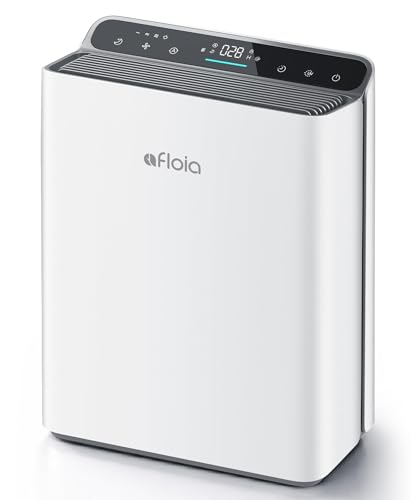
The Afloia 2,000 square foot purifier (B0CHW2LLSJ, $79.99) pairs carbon with a particle sensor and auto mode, adding a PM2.5 display, useful for tracking whether particulate is also part of the problem alongside VOCs.
Not for: situations where the source is clearly a specific chemical needing direct remediation
Expert: Best for a larger open space with a persistent source
Who it is for: an open-plan living area or a whole floor with new flooring or renovation off-gassing
- Expert pick
PuroAir 400 HEPA Air Purifiers for Home Large Room Pets Filter 2,000 Ft2
- HEPA claimed
- carbon stage
$259.99 Check pricePrices change often
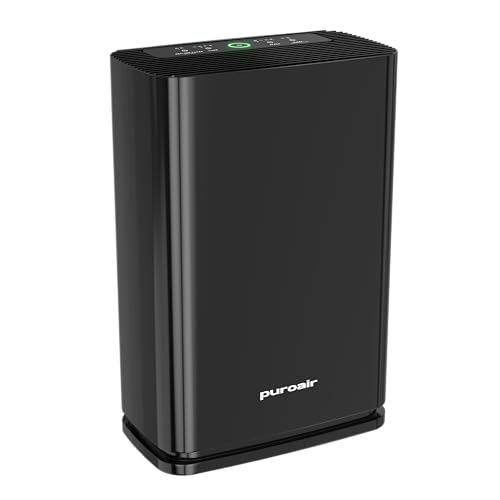
The PuroAir 400 (B0C3FXZLZ5, $259.99) combines true HEPA and carbon at a 2,000 square foot claim, the largest coverage among these picks, for a persistent source spread across an open floor plan.
Not for: anyone who has not first tried increasing ventilation, which will do more for VOCs than any of these units alone
| Approach | Effect on VOCs |
|---|---|
| Opening windows, running exhaust fans | Removes VOCs directly and completely while active |
| A thick, dedicated activated carbon bed | Adsorbs some VOCs, capacity is limited and finite |
| A thin carbon layer bundled into a HEPA cartridge | Limited adsorption, saturates faster |
| True HEPA filtration alone | Does essentially nothing for VOCs; they pass through as a gas |
Why doesn’t a HEPA filter remove VOCs?
Volatile organic compounds are gases, not particulate. A true HEPA filter works by mechanically intercepting solid or liquid particles as air passes through its media; a gas molecule is far smaller than any particle a HEPA filter is rated to capture and passes through the filter fiber essentially unaffected, the same way air itself passes through the fiber rather than being trapped by it.
This matters because a HEPA rating, no matter how high, tells a shopper nothing about VOC performance. A purifier marketed heavily around its HEPA efficiency but light on carbon detail is very likely a poor choice for off-gassing specifically, even if it excels at particulate, and a shopper focused only on the HEPA number will not notice that gap until the smell has not improved.
What actually removes VOCs from indoor air?
Activated carbon adsorbs many VOCs by trapping gas molecules in the carbon’s porous structure, but the amount of carbon matters directly: a thin layer bundled into a combination filter has limited total surface area and saturates faster than a thicker, dedicated carbon bed. Once saturated, that carbon stops adsorbing new VOCs even though the filter may look and feel unchanged, since saturation is an invisible chemical limit rather than a visible clog like a dust-loaded HEPA filter would show.
Most purifiers marketed with a generic "carbon" or "odor" filter, without stating the carbon’s weight or thickness, are describing a thin supplementary layer rather than a substantial adsorption bed. None of the listings referenced on this page state carbon mass in ounces or grams, which is typical for this category and worth noting as a real limitation of what a shopper can verify before buying, rather than a gap specific to any one brand or product listed here.
Does ventilation actually beat filtration for off-gassing?
Yes, directly and by a wide margin. Opening windows or running exhaust ventilation exchanges indoor air for outdoor air, removing VOCs from the room entirely rather than routing them through a carbon bed with finite capacity. For an acute off-gassing event, such as fresh paint or new flooring, increased ventilation for the first several days does more to reduce VOC exposure than any purifier running continuously, since fresh outdoor air simply has none of the VOC concentration building up indoors.
A carbon-equipped purifier is a reasonable supplement when ventilation alone is not practical, such as during cold weather or in a room without operable windows, but it should be treated as a secondary measure. None of the picks on this page are recommended as a substitute for increasing airflow when that option exists, regardless of how large a coverage claim any individual unit carries.
How would someone even know if VOCs are a problem in a room?
A persistent chemical, paint-like or "new" smell that does not fade after a few days is a common practical sign, though smell alone does not indicate concentration. A dedicated VOC or air quality monitor with a metal-oxide or similar sensor can track relative VOC levels over time, though it is worth knowing that cheap VOC sensors typically report an index, a relative number, rather than a calibrated concentration in parts per billion, which is a limitation of the sensor technology rather than any specific monitor brand.
This site’s air quality monitor review covers that distinction in more detail. For a purifier-only decision, the practical approach is to increase ventilation during any known off-gassing event, new furniture, fresh paint, new flooring, and treat a carbon-equipped purifier as ongoing support rather than the primary fix, checking back in with a monitor if one is available to confirm the trend is moving in the right direction.
Should a VOC purifier also have a strong particulate rating?
It helps but is not the primary spec to shop on for this specific problem. Every pick on this page also includes true HEPA filtration, which is useful because new furniture, flooring and renovation work frequently generate dust and particulate alongside VOCs, so a combination unit handles both at once rather than needing a separate particulate purifier taking up a second spot in the room.
The Expert tier pick, the PuroAir 400, is the strongest all-around choice here specifically because it pairs a meaningful carbon stage with true HEPA at the largest coverage claim among these picks, useful when both particulate and off-gassing are present across an open floor plan following a larger renovation project.
Is there a health claim to make about VOC filtration?
No specific health outcome is claimed for any product on this page. A carbon-equipped purifier reduces the measured concentration of adsorbed VOCs in the air passing through it; it does not treat, cure or prevent any respiratory condition or symptom associated with chemical sensitivity or off-gassing exposure, and no listing referenced here is read as making that claim either.
That distinction matters because VOC exposure and its health effects vary widely by specific compound and concentration, and no consumer-grade purifier on the market, including anything recommended here, has been verified by this site to address a specific health outcome, which is why the arithmetic and mechanisms above are the focus rather than any promised result.
Does room size change the tradeoff, and how long does an off-gassing source keep producing VOCs?
In a small, enclosed room, a carbon-equipped purifier has an easier job relative to the room’s total air volume, since there is simply less air to work through repeatedly, and a modest carbon bed can still make a measurable dent in VOC concentration over time. In a large open-plan space, the same carbon bed is cycling through a much bigger air volume, so its relative impact per pass is smaller even though the purifier itself has not changed.
This is part of why the Expert tier pick on this page carries the largest coverage claim among these picks: a bigger carbon-equipped unit is a partial answer to a bigger room, but it does not fully offset the advantage ventilation has at any scale, since opening windows exchanges the entire room’s air rather than filtering a fraction of it repeatedly through a fixed carbon bed, whatever that bed’s size.
New furniture, fresh paint and new flooring tend to off-gas most heavily in the first days after installation, tapering off over following weeks, though the exact timeline varies by material and product. A carbon-equipped purifier running continuously during that tapering period is doing more relative work early on, when the source is strongest, than it will later once off-gassing has mostly settled, which is another reason ventilation matters most in that same early window.
Some materials, particularly certain engineered woods and adhesives, continue off-gassing at a low background level for a much longer stretch than the initial acute period. In that longer-term case, sustained ventilation, such as periodically opening windows rather than sealing a room continuously, remains the more reliable ongoing approach compared to relying on a purifier’s carbon stage indefinitely, since a carbon bed exhausted months into a slow off-gassing source is not always obvious from the outside.
How we chose
Every product on this page was researched from published manufacturer specifications and owner reports on retail listings, not from in-person testing of VOC removal, which requires laboratory-grade measurement this site does not perform.
Selection prioritized units where activated carbon was described as a distinct, named stage rather than an unspecified "odor" feature, combined with true HEPA for the particulate that typically accompanies an off-gassing source.
Buying tips
Does a bigger HEPA number mean better VOC removal?
No. HEPA efficiency describes particulate capture, not gas adsorption. For VOCs specifically, check whether a listing names a carbon stage at all before looking at HEPA specs.
Should I buy a purifier instead of opening a window during off-gassing?
Ventilation removes VOCs from a room directly and should be the first response to an acute source like fresh paint. A carbon-equipped purifier is a reasonable supplement when ventilation is not practical, not a replacement for it.
How do I know if a purifier’s carbon layer is substantial or thin?
Most listings do not state carbon weight or thickness, which is itself informative: a listing that highlights a specific carbon mass or a dedicated carbon compartment is more likely to have a meaningful adsorption bed than one that mentions carbon only in passing.
Other options worth knowing about
- MOOKA
MOOKA H13 HEPA Air Purifier for Home Pet Large Room Up to 1300ft2, Black
- HEPA claimed
- carbon stage
- has a UV lamp
$46.98 Check pricePrices change often - MOOKA
MOOKA Air Purifiers for Home Room up to 1076ft2, True HEPA Filter, B-D02L
- HEPA claimed
- carbon stage
$49.99 Check pricePrices change often - MOOKA
MOOKA Air Purifiers for Home Room up to 1076ft2, True HEPA Filter, B-D02L
- HEPA claimed
- carbon stage
$49.99 Check pricePrices change often - Clorox
Clorox Small Room Air Purifiers for Bedroom Home, True HEPA Filter
- HEPA claimed
$59.95 Check pricePrices change often - Afloia
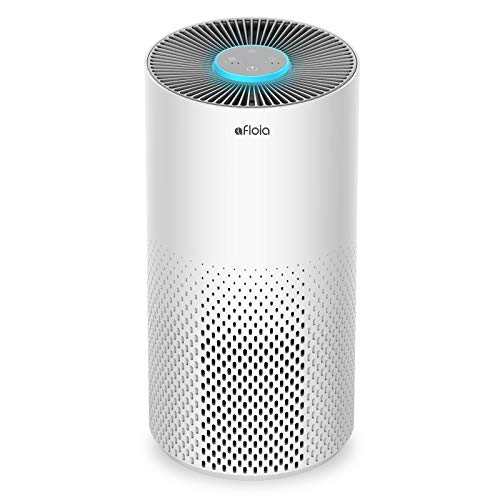
Afloia Air Purifier for Home Bedroom Large Room up to 1500 Sq Ft
- washable pre-filter
$59.97 Check pricePrices change often


Common questions
Will a HEPA air purifier remove VOCs from new furniture or paint?
No. Volatile organic compounds are gases, and a true HEPA filter captures particulate by mechanical interception, which does not affect gas molecules. VOC removal requires activated carbon or another adsorption media; a purifier’s HEPA rating says nothing about how it performs against off-gassing, so checking for a named carbon stage matters more than the HEPA number here.
Is opening a window more effective than an air purifier for off-gassing?
Yes, for an acute source like fresh paint or new flooring, ventilation exchanges indoor air for outdoor air and removes VOCs directly rather than routing them through a carbon filter with finite capacity. Increasing airflow for the first several days after an off-gassing event does more than any purifier running continuously in a closed room.
How much carbon does a typical air purifier carbon filter actually contain?
Most consumer listings do not state the carbon’s weight or thickness, and a bundled carbon layer inside a combination HEPA cartridge is usually a thin supplementary layer rather than a substantial adsorption bed. A listing that names a specific carbon mass or a dedicated carbon compartment is a better sign of real adsorption capacity than one mentioning carbon only in passing.
What happens once a carbon filter’s adsorption capacity is used up?
The carbon stops adsorbing new VOCs even though the filter may look physically unchanged, since saturation is a chemical limit rather than a visible clog. A thin carbon layer saturates faster than a thicker dedicated bed, which is part of why carbon mass matters more than a generic "odor filter" label for ongoing VOC exposure.
Does a cheap VOC sensor give an accurate reading of chemical concentration?
Typically no. Cheap VOC sensors, usually metal-oxide based, report an index, a relative number showing whether VOC levels are rising or falling, rather than a calibrated concentration in parts per billion. That is useful for spotting a trend but should not be read as a precise measurement of a specific chemical’s level.
Should a VOC-focused purifier also have true HEPA filtration?
It is a reasonable combination, since new furniture, flooring and renovation work commonly generate both particulate and VOCs at the same time. True HEPA handles the particulate side while a carbon stage handles VOCs, so a unit with both addresses more of a typical off-gassing situation than either feature alone.