VOCs and off-gassing: why ventilation beats filtration
Quick answer
Volatile organic compounds off-gas from paint, new furniture, flooring and household products, and activated carbon in a purifier adsorbs them by mass, meaning a thin carbon layer saturates fast. A unit with a real combined HEPA and carbon stage like the PuroAir 400, rated for 2,000 sq ft at $259.99, helps, but simple ventilation, bringing in outdoor air, usually dilutes VOCs faster than any single purifier.
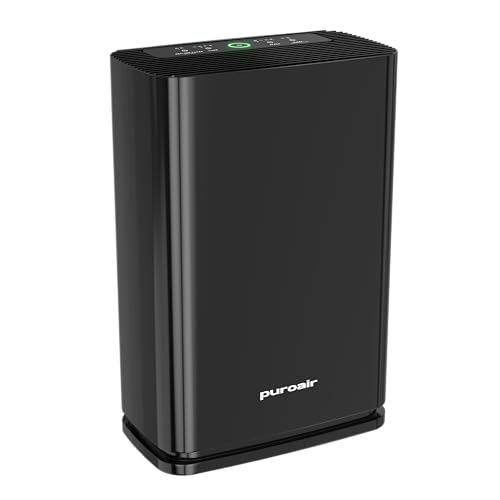
PuroAir 400 HEPA Air Purifiers for Home Large Room Pets Filter 2,000 Ft2
The PuroAir 400 pairs true HEPA with an activated carbon stage rather than a thin cosmetic carbon layer, and its 2,000 sq ft rating gives it meaningful CADR to work with in a living room or open-plan space where new furniture or flooring is off-gassing. It has no ionizer or UV mode to complicate the picture, just mechanical filtration and adsorption.
Coverage claims vary in what air change rate they assume, so check a published airflow figure against your own room rather than the room size on the box.
| Approach | How it works | Main limitation |
|---|---|---|
| Opening windows / exhaust fans | Dilutes indoor VOC concentration with outdoor air | Depends on outdoor air quality and weather |
| Activated carbon filtration | Adsorbs VOC molecules onto the carbon’s surface | Carbon saturates and needs replacement; thin layers saturate fast |
| Source control | Removes or delays bringing in the off-gassing item | Not always practical for furniture already installed |
| Time | Off-gassing rate declines naturally over weeks to months | Does not help with acute, ongoing sources |
What actually is a VOC, and where does off-gassing come from?
Volatile organic compounds are carbon-based chemicals that evaporate into the air at normal room temperature, and they come from an unusually wide range of household sources: fresh paint, new furniture built with pressed wood adhesives, vinyl flooring, carpet backing, cleaning products, and even some air fresheners. "Off-gassing" is the process of those compounds evaporating out of a product over time, and it is typically fastest right after the product is new and slows gradually afterward.
Because VOCs come from so many different materials at once, a room can have elevated total VOC levels from several small sources combined even when no single item seems obviously to blame, which is part of why source identification is harder than it is for something like pet dander or pollen.
Does an air purifier actually remove VOCs?
A standard true HEPA filter does not remove VOCs at all, because HEPA media is a mechanical filter built to capture particles, not gas molecules. VOC removal in a purifier comes entirely from an activated carbon stage, which works by adsorption: VOC molecules stick to the enormous internal surface area of the carbon rather than being physically strained out the way particles are. A purifier marketed for VOCs without a real carbon stage is not equipped to do that job regardless of its HEPA rating.
Why does carbon mass matter more than the fact a filter has carbon at all?
Carbon adsorbs VOCs by mass, meaning the more carbon media a filter actually contains, the more total capacity it has before it saturates and stops adsorbing new compounds effectively. Many budget filters include a thin, cosmetic layer of carbon, sometimes just a coating on one side of a HEPA filter, and that layer saturates within days or weeks of exposure to a real off-gassing source. A filter built around a genuine carbon bed, with real weight and depth to the media, lasts substantially longer under the same load.
This is worth checking directly on a product listing rather than assuming: "activated carbon" appearing in the name does not guarantee a meaningful amount of it is actually inside.
Why does ventilation usually beat filtration for VOCs?
Opening windows, running a bathroom or kitchen exhaust fan, or using a whole-house ventilation system brings in outdoor air that, in most locations most of the time, carries a far lower VOC concentration than a room with a fresh coat of paint or new furniture. Dilution with outdoor air lowers the concentration directly and continuously without any media to saturate, which is why it often outperforms a purifier running the same amount of time in the same room.
The tradeoff is that ventilation depends on outdoor conditions: it works less well during extreme outdoor temperatures when windows have to stay closed, or in an area with its own outdoor air quality problems. In those situations, carbon filtration becomes the more practical fallback rather than the first choice.
How is a VOC problem actually measured?
Consumer VOC monitors report a total VOC figure, usually in parts per billion, using a sensor that responds to a broad mix of compounds rather than identifying any single one. There is no equivalent to the AHAM AC-1 CADR standard for VOC removal performance, so comparing purifiers on VOC claims is less standardized than comparing them on particulate CADR; a monitor in the room gives a more direct read on whether a given approach, ventilation or filtration, is actually working than trusting a spec sheet claim alone.
Equipment mentioned on this page
- MOOKA
MOOKA H13 HEPA Air Purifier for Home Pet Large Room Up to 1300ft2, Black
- HEPA claimed
- carbon stage
- has a UV lamp
$46.98 Check pricePrices change often - MOOKA
MOOKA Air Purifiers for Home Room up to 1076ft2, True HEPA Filter, B-D02L
- HEPA claimed
- carbon stage
$49.99 Check pricePrices change often - MOOKA
MOOKA Air Purifiers for Home Room up to 1076ft2, True HEPA Filter, B-D02L
- HEPA claimed
- carbon stage
$49.99 Check pricePrices change often - Clorox
Clorox Small Room Air Purifiers for Bedroom Home, True HEPA Filter
- HEPA claimed
$59.95 Check pricePrices change often - Afloia
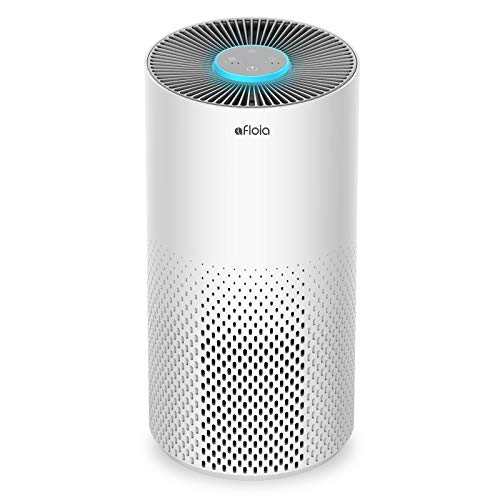
Afloia Air Purifier for Home Bedroom Large Room up to 1500 Sq Ft
- washable pre-filter
$59.97 Check pricePrices change often


Common questions
How long does new furniture keep off-gassing VOCs?
Off-gassing rates are highest right after a product is new and decline gradually over the following weeks to months, though the exact timeline varies by material and how it was manufactured. Pressed wood products with adhesive-heavy construction tend to off-gas longer than solid wood. There is no fixed universal timeline, but the trend is a steady decline rather than a sudden stop.
Does a HEPA filter without carbon do anything for VOCs?
No. HEPA media is a mechanical particle filter and does not adsorb gas-phase compounds like VOCs at all. Any VOC reduction from a purifier comes specifically from an activated carbon stage, so a HEPA-only unit, however good at particulate removal, has no meaningful effect on VOC concentration, and a listing that only mentions HEPA should not be assumed to help with off-gassing.
Can opening a window make VOC exposure worse instead of better?
It can, if outdoor air quality is significantly worse than indoor air at that moment, such as during a wildfire smoke event or in a location with heavy outdoor pollution. In typical conditions, though, outdoor air carries far fewer VOCs than a room with an active indoor source, which is why ventilation usually helps rather than hurts.
How often does an activated carbon filter need to be replaced for VOC control?
More often than a pure HEPA filter in a room with an active VOC source, since carbon capacity is used up by adsorption rather than by particle load. A thin carbon layer can saturate within weeks under a strong source like fresh paint; a filter with a substantial carbon bed lasts longer, but there is no universal interval since it depends entirely on the VOC load in that specific room.
Do low-VOC or zero-VOC paint and furniture labels actually mean less off-gassing?
Generally yes, products marketed as low-VOC or zero-VOC are formulated to off-gas less than standard versions of the same product, though the labeling is based on specific regulated compounds and does not guarantee zero total off-gassing from every ingredient. Choosing lower-VOC materials at the source reduces the total load a room has to deal with either way.
Is a VOC monitor worth buying before choosing between ventilation and filtration?
It is useful because VOC removal, unlike particulate CADR, is not standardized the same way, so a monitor gives a direct before-and-after read on whether a specific approach is actually lowering the concentration in that room. Without one, a household is relying on a spec sheet claim rather than a measurement of what is actually happening in the space.