Do air purifiers actually work?
Quick answer
Yes, in the specific and measurable sense that a correctly sized purifier reduces airborne particulate concentration in the room it sits in, at a rate that follows directly from its CADR and the room’s volume; that is the extent of what any air purifier can be honestly said to do.
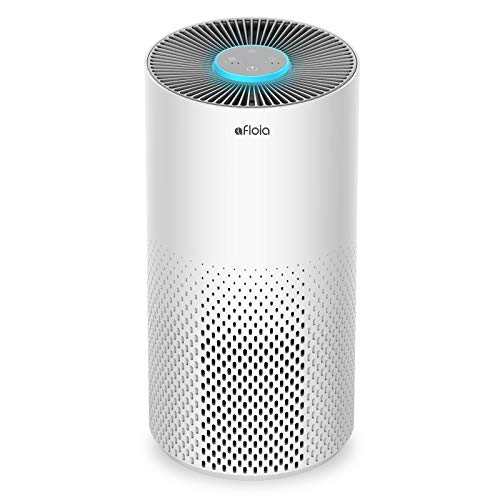
Afloia Air Purifier for Home Bedroom Large Room up to 1500 Sq Ft
A machine that publishes a real airflow figure, so the arithmetic on this page can actually be applied to it.
Coverage claims vary in what air change rate they assume, so check a published airflow figure against your own room rather than the room size on the box.
| Claim | Measured? | What is actually known |
|---|---|---|
| Reduces airborne particle concentration | Yes | CADR and ACH describe this directly and are testable |
| Removes gases like VOCs | Only with carbon media | HEPA alone does not touch gases; carbon adsorption does |
| Reduces radon or carbon monoxide | No | Neither is a particle; filtration does not address either gas |
| Improves a specific health condition | Not measured by this site | Outside the scope of a particle removal measurement |
What is actually measured, and what is not
A purifier’s CADR, tested under AHAM AC-1, and the resulting air changes per hour in a specific room are measurable, repeatable numbers. Given a machine’s smoke CADR and a room’s volume, the time to remove 90 percent of airborne particles in that well-mixed room follows a fixed formula: t equals the natural log of 10 divided by the ACH, in hours. That calculation is what "a purifier works" means in a measurable sense, and it is the extent of the claim this site makes.
What is not measured, by this site or by the AHAM AC-1 test itself, is any health outcome: whether reduced airborne particulate concentration changes symptoms, illness frequency, or any medical condition for a specific reader. That is a different kind of question than a CFM measurement in a sealed chamber, and this site does not make that claim in either direction.
This distinction matters because it draws a clean line between two different kinds of claims that get blended together in marketing constantly. "This machine removes X percent of particles at this size in this amount of time" is a measurable, testable, and checkable claim, backed by a specific published standard. "This machine will make you feel better" is a different kind of claim entirely, resting on a chain of assumptions about a specific person’s body that a CADR test was never designed to establish, and no listing on this site makes that second kind of claim.
Where a purifier clearly does something
For airborne particulate, dust, pollen, pet dander, mold spores, and smoke particles, a correctly sized and placed purifier measurably reduces concentration in the room it sits in, and that reduction follows the CADR and ACH math directly. This is true regardless of whether a reader’s specific symptoms improve, because it is a statement about particle counts in air, not about a person’s body.
This holds across every particle type CADR is tested against, though at different rates depending on which of the three CADR numbers, smoke, dust, or pollen, applies to the specific particle in question. A room with a wildfire smoke problem sees its improvement tracked by the smoke CADR figure; a room with a seasonal pollen problem sees its improvement tracked by the higher pollen CADR figure, and clears faster for the same machine at the same fan speed.
A purifier with an activated carbon layer also measurably reduces certain gas-phase odors and VOCs through adsorption, a separate mechanism from particle filtration, though carbon media saturates and needs replacement on its own schedule, generally shorter than a HEPA filter’s.
A standalone PM2.5 monitor, covered in `/guides/reading-an-air-quality-monitor/`, is the most direct way to see this reduction happen in a specific room: run the monitor before turning the purifier on, then again after a period of continuous operation, and the drop in reported PM2.5 concentration is the measurable effect this page is describing, independent of anything to do with how anyone in the room feels.
Where a purifier does nothing, and it is worth saying so plainly
A filter does nothing for radon, a gas that seeps up from soil and rock, or carbon monoxide, a combustion by-product gas; neither is a particle, and no filter media addresses either one. A household concerned about radon needs a radon-specific detector and, if levels are elevated, sub-slab or soil-based mitigation, not an air purifier. A household concerned about carbon monoxide needs a dedicated CO alarm, since CO poisoning is acute and fast-moving in a way no purifier is designed to respond to.
Saying plainly that a purifier does not help with these two specific hazards is more useful to a reader than another paragraph hedging around it, since the actual fix for each is a different product entirely, covered in `/problems/radon/` and `/problems/carbon-monoxide/`.
The same honesty applies to structural moisture problems: a purifier can measurably reduce airborne mold spore concentration in a room, but it does nothing about an active moisture source behind a wall or under a floor that is generating those spores in the first place. `/problems/mold-and-musty-smells/` covers what actually addresses the source, which is a separate step from running a purifier in the affected room. A purifier running continuously in a room with an unaddressed moisture problem will keep reducing the spore count it can reach while the source keeps generating more, which is a losing arithmetic until the source itself is fixed.
Why "does it work" depends entirely on sizing and placement
An undersized purifier, or a correctly sized one placed in a corner behind furniture, delivers meaningfully less than its rated CADR into the actual room, which is a placement and sizing failure rather than evidence that purifiers as a category do not work. `/guides/how-to-size-an-air-purifier/` and `/guides/where-to-place-an-air-purifier/` cover getting both of those right, which is most of what determines whether a specific setup performs the way the CADR number on the box suggests it should. A badly loaded filter, covered in `/guides/how-often-to-change-a-filter/`, has the same effect: the machine has not stopped working in a mechanical sense, but its real-world CADR has dropped well below its rated figure.
Put together, the honest framing of "does it work" is closer to "does this specific setup, in this specific room, with this specific filter condition, deliver its rated CADR into the space." Answered that way, the question stops being a matter of opinion about the technology and becomes a checklist of three specific, fixable things.
What a reasonable expectation actually looks like
A reasonable, measurable expectation is: a correctly sized purifier, running continuously in a well-placed spot, reduces airborne particulate concentration in that specific room over time, at a rate calculable from its CADR and the room’s volume. It does not claim to sterilize a room, eliminate every particle instantly, or address hazards outside its mechanism, like gas leaks or structural mold growth behind a wall. Anyone advertising outcomes beyond that measurable claim, especially a specific health outcome, is making a claim this site does not make and cannot verify from a CADR number.
This is also why the sizing, placement, and filter guidance elsewhere on this site matters more than any single product recommendation: the mechanism behind a purifier is simple and well understood, and nearly all of the variance in how well it actually performs in a specific home comes down to getting those three practical decisions right rather than which brand name is on the box.
Equipment mentioned on this page
- Clorox
Clorox Small Room Air Purifiers for Bedroom Home, True HEPA Filter
- HEPA claimed
$59.95 Check pricePrices change often - Frida
Frida Baby 3-in-1 Air Purifier, Sound Machine + Nightlight, Auto-Off Timer
- HEPA claimed
$59.97 Check pricePrices change often - Afloia
Afloia Air Purifier for Home Bedroom Large Room up to 1076 Sq Ft
$69.98 Check pricePrices change often - Levoit
Levoit Air Purifier for Home Pets Bedroom Dorm Room, Smart & Voice Control
- carbon stage
$69.99 Check pricePrices change often - Afloia
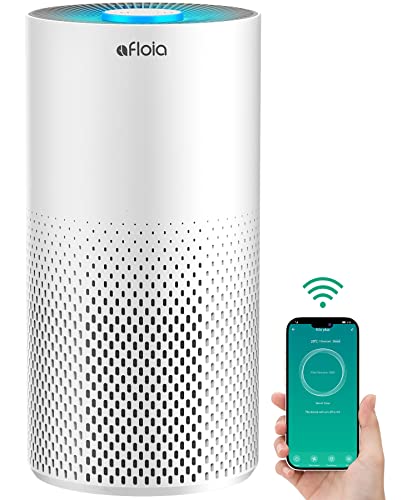
Afloia Smart Air Purifier for Home Large Rooms Bedroom, Up to 1,076 sq ft
- app or voice
$69.99 Check pricePrices change often


Common questions
Do air purifiers actually reduce dust in a room?
Yes, measurably. A correctly sized purifier running continuously reduces airborne dust particle concentration in the room it sits in, at a rate that follows from its dust CADR and the room’s air volume. It will not stop dust from settling on surfaces entirely, since some dust settles before ever reaching the machine’s intake.
Will an air purifier help with my allergies?
This site does not make health outcome claims. What is measurable is that a correctly sized purifier reduces airborne concentrations of common allergy triggers like pollen and pet dander in the room it operates in; whether that translates to symptom relief for a specific person is outside what a CADR measurement can answer.
Can an air purifier remove smells from a room?
HEPA filtration alone does not remove odors, since odors are gas-phase molecules, not particles. A purifier with an activated carbon layer can reduce certain odors through adsorption, a separate mechanism, though carbon media saturates faster than HEPA media and needs its own replacement schedule.
Does an air purifier help with radon?
No. Radon is a gas, not a particle, and no filter media, HEPA or carbon, addresses it. A radon concern needs a dedicated radon detector and, if levels are elevated, mitigation methods aimed at the gas’s source, not an air purifier.
Why do some people say air purifiers do not work?
Often because the unit in question was undersized for the room, placed in a corner with blocked airflow, or running on a badly clogged filter, all of which measurably reduce real-world performance below the rated CADR. The underlying mechanism, fan pulling air through filter media, works as measured; the common failure points are sizing, placement, and filter maintenance.
How can I check if my purifier is actually working?
A standalone air quality monitor reading PM2.5 concentration in the room, checked before and after running the purifier for a period of time, gives a direct, measurable answer for that specific room. `/guides/reading-an-air-quality-monitor/` covers what a monitor can and cannot tell you.