What CADR actually measures
Quick answer
CADR (Clean Air Delivery Rate) is measured under the AHAM AC-1 standard in a sealed 1,008 cubic foot chamber, and a purifier carries three separate CADR numbers, for smoke, dust and pollen, because each particle size clears the chamber at a different rate.
The two thirds rule that turns CADR into a room size is a shopper convention, not part of the AHAM AC-1 standard.

DREO Air Purifier for Home, HEPA Sleep Mode, AHAM VERIFIDE Air Purifiers for Bedroom, Pets, Smoke, Dust, Pollen & Odors, PM2.5 Monitor, Auto & Turbo Mode, 4 Speeds, Scent Diffuser, DR-HAP008(Dreo 338)
The listing states an AHAM VERIFIDE smoke CADR of 115 CFM for a 178 square foot room, meaning that number came from an accredited lab running the AC-1 method rather than a marketing estimate.
Coverage claims vary in what air change rate they assume, so check a published airflow figure against your own room rather than the room size on the box.
| Particle tested | Approximate size | What a low number usually means |
|---|---|---|
| Smoke | 0.09 to 1.0 micron | Weakest link for wildfire smoke and cooking smoke |
| Dust | 0.5 to 3.0 micron | Weakest link for household dust and drywall particles |
| Pollen | 5 to 11 micron | Usually the highest of the three, least useful for comparing units |
What happens inside an AHAM AC-1 test
A test lab loads a known quantity of test particles into a sealed 1,008 cubic foot chamber with the purifier running inside it, then tracks how fast the particle count falls compared to natural decay with the machine off. The result is converted into a delivery rate in cubic feet per minute, which is the CADR number printed on the box or the AHAM Verifide seal.
That chamber is a fixed, controlled box. It has no doors opening, no HVAC return pulling air sideways, and no furniture blocking the intake. A CADR number is a statement about the machine, not a promise about your specific room.
The 1,008 cubic foot figure itself is the standardized chamber volume specified by the AC-1 method, so every machine tested under it is measured against the same fixed space regardless of what coverage area the manufacturer later markets it for. That consistency is what makes CADR numbers comparable across brands in the first place: two machines from different manufacturers, tested under the same protocol in the same size chamber, produce numbers that mean the same thing, unlike a manufacturer-chosen coverage claim, which carries no such guarantee.
Why does one machine get three different numbers
AHAM AC-1 runs the same chamber test three times with three different challenge particles: tobacco smoke, dust, and pollen. Smoke particles are the smallest of the three and the hardest for a fan and filter combination to clear quickly, so the smoke CADR is usually the lowest number on the label. Pollen particles are the largest and clear fastest, so the pollen CADR is usually the highest.
When a listing only advertises one CADR figure, it is almost always the highest of the three. If wildfire smoke or cooking smoke is the actual problem in the room, the smoke CADR is the number that matters, and it can be meaningfully lower than the number on the box.
The gap between the three numbers on a single machine also tells you something about its filter design. A unit with a smoke CADR close to its pollen CADR is handling small particles almost as efficiently as large ones, while a wide gap between the two suggests the filter and fan combination loses more ground against the smallest particles specifically. Reading all three numbers together, rather than the single headline figure, gives a fuller picture of where a specific machine’s strengths and weaknesses actually sit.
What is the two thirds rule, and is it a standard
The two thirds rule is a shopper convention published by AHAM alongside the AC-1 standard: choose a smoke CADR that is at least two thirds of the room’s floor area in square feet. It is not itself part of the measured test; the test produces a CFM number, and the two thirds figure is a recommended way to translate that number into a sizing decision.
The convention assumes an 8 foot ceiling. A room with a taller or shorter ceiling changes the actual air volume, so the two thirds shortcut gets less accurate the further a room departs from that assumption.
It is worth being precise about what kind of figure this is, because the distinction gets blurred often. AHAM AC-1 is a STANDARD: a published, repeatable test method that produces the CFM numbers on the label. The two thirds rule is a CONVENTION: a rule of thumb built on top of those numbers to help a shopper translate CFM into a room size decision without doing the underlying arithmetic themselves. Neither is wrong, but conflating the two, treating the shopping rule as if it carried the same rigor as the lab test, is where sizing mistakes start.
Why the two thirds rule and 5 air changes an hour are the same arithmetic
Required CADR in CFM works out to floor area multiplied by ceiling height multiplied by air changes per hour, divided by 60. Fill in an 8 foot ceiling and 5 air changes an hour and the equation becomes floor area times 8 times 5 divided by 60, which reduces to floor area times 0.667. That is exactly the two thirds rule.
So a shopper following the two thirds convention is, without necessarily realizing it, sizing for 5 air changes an hour, which is the guidance figure commonly used for allergy-sensitive households at an 8 foot ceiling. Change the ceiling height or the target ACH and the multiplier changes with it; the two thirds number is not a universal constant, it is one specific case of the general formula.
Run the same formula at a 9 foot ceiling instead: floor area times 9 times 5 divided by 60 reduces to floor area times 0.75, a noticeably higher multiplier than two thirds. A shopper in a room with taller-than-standard ceilings who applies the flat two thirds rule without adjusting for that extra volume will undersize the purifier relative to the same 5 ACH target, even though the rule of thumb they followed is the same one that works correctly at 8 feet.
What CADR does not tell you
CADR says nothing about filter life, noise at the speed that actually delivers that airflow, or how air moves through your specific floor plan. A machine can have an excellent smoke CADR and still underperform in a room with a single doorway feeding it stale air from the rest of the house, because the chamber test has no doorway.
It also does not measure gases. CADR is a particulate measurement; it tells you nothing about a filter’s ability to reduce VOCs or odors, which is a separate claim tied to activated carbon media rather than the AC-1 particle test.
A machine placed in a corner or wedged against a blocked wall can deliver a fraction of its rated CADR into the actual room, since the chamber test has open, unobstructed airflow on every side. The number on the box is a ceiling on what the machine can achieve, not a floor; placement, covered separately in `/guides/where-to-place-an-air-purifier/`, decides how much of that ceiling is actually realized in a given room.
Where to actually find the numbers for a specific machine
Look for the AHAM Verifide seal on the packaging or listing, which means the CADR numbers were independently verified rather than self-reported. Manufacturers that skip AHAM certification often publish a single, higher, unverified CFM figure or a bare coverage area claim with no stated air change rate behind it, which is a different and less useful number.
When comparing two machines side by side, prioritize the one that discloses all three CADR figures and states its AHAM Verifide status over one that leads with a large, unverified coverage area number and no CFM breakdown at all. The disclosed numbers are what let you run the actual sizing formula for your own room; the bare coverage claim is a marketing shortcut you cannot independently check, and it is worth treating that gap in disclosure itself as useful information about how the machine was tested.
Equipment mentioned on this page
- MOOKA
MOOKA H13 HEPA Air Purifier for Home Pet Large Room Up to 1300ft2, Black
- HEPA claimed
- carbon stage
- has a UV lamp
$46.98 Check pricePrices change often - MOOKA
MOOKA Air Purifiers for Home Room up to 1076ft2, True HEPA Filter, B-D02L
- HEPA claimed
- carbon stage
$49.99 Check pricePrices change often - MOOKA
MOOKA Air Purifiers for Home Room up to 1076ft2, True HEPA Filter, B-D02L
- HEPA claimed
- carbon stage
$49.99 Check pricePrices change often - Clorox
Clorox Small Room Air Purifiers for Bedroom Home, True HEPA Filter
- HEPA claimed
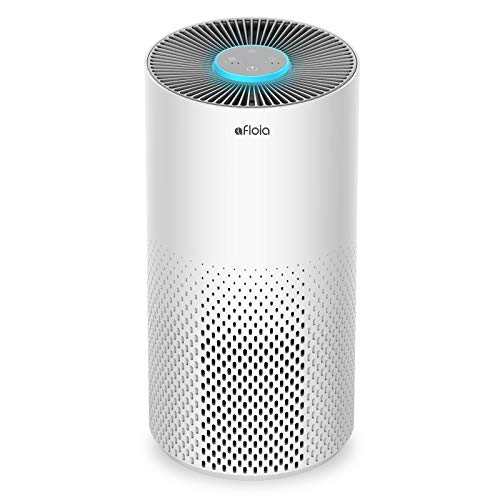
$59.95 Check pricePrices change often - Afloia
Afloia Air Purifier for Home Bedroom Large Room up to 1500 Sq Ft
- washable pre-filter
$59.97 Check pricePrices change often


Common questions
What does a higher CADR number actually mean?
It means the machine cleared that specific test particle faster inside the 1,008 cubic foot AHAM AC-1 chamber, measured in cubic feet per minute. A higher smoke CADR means faster smoke particle removal in that sealed chamber; it does not directly describe how fast your living room clears, since your room has doors, drafts, and a different volume than the test box.
Which of the three CADR numbers should I actually use?
Use the smoke CADR for cooking smoke, wildfire smoke, or cigarette smoke, since it is measured with the smallest particle and is usually the lowest, most conservative number. Use the dust CADR for general household dust. The pollen CADR is the least useful for sizing decisions because it is almost always the highest of the three and rarely the limiting factor.
Is CADR the same as a MERV rating?
No. CADR (AHAM AC-1) measures how much clean air a whole machine, fan and filter together, delivers per minute in a sealed chamber. MERV (ASHRAE 52.2) measures how efficiently a filter medium alone captures particles of a given size as air passes through it once. A filter can have a high MERV rating and still sit in a machine with a low CADR if the fan cannot push much air through it.
Does a bigger CADR number always mean a bigger, louder machine?
Usually, yes, because moving more cubic feet of air per minute takes a larger fan or a faster motor speed, and both raise noise. This is why the CADR printed on the box is often measured at a higher fan speed than the quiet, sleep-mode speed a machine actually runs at overnight.
Why do two machines with the same square foot coverage claim have different CADR numbers?
A coverage claim in square feet is not standardized the way CADR is; a manufacturer can state whatever air change rate it wants behind that square footage figure. Two machines claiming the same coverage might be assuming very different air change rates, which is exactly why the underlying CADR number, not the coverage claim, is the figure worth comparing.
Do smaller desktop purifiers get tested under AHAM AC-1 too?
Many do not carry a verified CADR at all, and instead advertise a square footage figure with no stated air change rate. Where a compact or desktop unit does list a CADR, the same three-particle test method and the same sealed 1,008 cubic foot chamber apply regardless of the machine’s size.