Best indoor air quality monitors
Quick answer
No single monitor covers every pollutant well; the Amazon Smart Air Quality Monitor (B08W8KS8D3, $69.99) reads temperature, humidity, carbon monoxide, PM2.5 and VOCs, but radon needs a dedicated detector like the Airthings 325 (B0F84C4ZZM, $179.99).
A cheap VOC sensor typically reports a relative index, not a calibrated concentration in parts per billion.

Amazon Smart Air Quality Monitor, Detects temperature, humidity, carbon monoxide, PM2.5 and VOCs, Get notifications when air quality drops, Works with Alexa
The Amazon Smart Air Quality Monitor covers temperature, humidity, carbon monoxide, PM2.5 and VOCs in one $69.99 device with wifi reporting, a reasonable general-purpose choice for a household that has not identified a specific pollutant to track.
Coverage claims vary in what air change rate they assume, so check a machine's published airflow against your own room rather than the room size on the box.
The three tiers
Beginner: Best for a simple PM2.5 reading
Who it is for: someone who wants a basic particulate reading without tracking gases
- Beginner pick
GoveeLife Smart Air Quality Monitor with PM2.5 H5106, LED Display Wired
- app or voice
$45.99 Check pricePrices change often

The GoveeLife monitor (B0BZV1XG6Y, $45.99) has a clear LED display focused on PM2.5, a straightforward way to see whether a purifier elsewhere in a room is keeping particulate down.
Not for: anyone who wants to track CO2, VOCs or radon, none of which this device measures
Intermediate: Best for tracking ventilation with CO2
Who it is for: a home office or bedroom where stuffiness and ventilation are the concern
- Intermediate pick
Aranet4 Indoor Air Quality Monitor, Wireless CO2 Detector for Home, Office
$189.00 Check pricePrices change often

The Aranet4 (B07YY7BH2W, $189.00) uses a non-dispersive infrared sensor, the accurate sensor type for CO2, reporting an actual concentration in parts per million rather than an index, which is what makes CO2 a genuinely useful ventilation indicator.
Not for: tracking VOCs or radon, which this device does not measure
Expert: Best for radon, which no other pick on this page measures
Who it is for: anyone testing a home for radon, especially with a basement or ground-contact living space

The Airthings 325 Corentium Home 2 (B0F84C4ZZM, $179.99) is a dedicated digital radon detector. Radon is a gas that PM2.5, CO2 and VOC sensors cannot detect at all, making this a separate purchase rather than an upgrade path from the other picks.
Not for: general everyday air quality tracking, since it is a single-purpose radon device
| Sensor class | What it measures | What it cannot tell you |
|---|---|---|
| PM2.5 particle sensor | Airborne particulate concentration | Gases: CO2, VOCs, radon, carbon monoxide |
| NDIR CO2 sensor | Carbon dioxide concentration, a ventilation indicator | Particulate, VOCs, radon |
| Metal-oxide VOC sensor | A relative VOC index, not a calibrated concentration | Which specific compound is present, or its exact level |
| Electrochemical CO sensor | Carbon monoxide, a combustion hazard, separate from CO2 | Radon, VOCs, particulate |
| Radon detector | Radon gas concentration over time | Everything else on this list |
Why doesn’t one monitor measure everything well?
Each pollutant on this page, particulate, carbon dioxide, volatile organic compounds, carbon monoxide and radon, requires a different sensor technology to measure accurately, and packing every sensor type into one inexpensive device means each one is usually a lower-quality version of what a dedicated single-purpose device would use. A monitor advertising "16 in 1" or similar broad coverage is typically prioritizing breadth over accuracy on any single measurement, since fitting that many sensor types into one small housing at a low price point has real engineering tradeoffs.
This is why this page picks by sensor class rather than recommending one monitor for every household. A general-purpose monitor covering several pollutants at moderate quality, like the top pick here, is a reasonable starting point; a household with a specific concern, ventilation, radon, or a known VOC source, is usually better served by a dedicated device for that one measurement rather than one more line item on a broad monitor’s spec sheet.
What is the difference between CO2 and CO, and why does it matter?
Carbon dioxide, CO2, is a normal byproduct of breathing that builds up in a poorly ventilated room and serves as a practical proxy for stale, under-ventilated air; elevated CO2 by itself is not toxic at typical indoor levels but signals that fresh air exchange is low, which is genuinely useful information even without being a direct health measurement. Carbon monoxide, CO, is a completely different, colorless and odorless gas produced by incomplete combustion, from a furnace, water heater, generator or attached garage, and it is dangerous at far lower concentrations.
These two gases are measured by different sensor types and are easy to confuse because of the similar name and abbreviation. A monitor that states it measures "CO" specifically for combustion safety and one that measures "CO2" for ventilation are answering different questions, and a household should know which one a given device actually covers before relying on it for either purpose, rather than assuming one covers the other.
Why does a cheap VOC sensor report an index instead of a real number?
Most consumer VOC sensors use a metal-oxide element that reacts to a broad range of volatile compounds without distinguishing which specific chemical is present or measuring its concentration precisely. Because of that, these sensors typically output a relative index, a number that goes up when VOC levels rise and down when they fall, rather than a calibrated reading in parts per billion for a named compound.
That index is genuinely useful for spotting a trend, such as confirming that ventilation is reducing VOC levels after fresh paint or new furniture, but it should not be read as an exact concentration the way a lab instrument would report one. A monitor that displays a specific ppb number from an inexpensive metal-oxide sensor is presenting more precision than the underlying sensor actually supports.
Why does radon need a completely separate device?
Radon is a radioactive gas that occurs naturally from soil and rock, entering homes primarily through basement and ground-contact areas, and none of the particulate, CO2, VOC or CO sensor types on this page detect it at all, regardless of how many other pollutants a given device claims to cover. A dedicated radon detector uses its own sensing method, typically tracking alpha particle activity over time, and reports a radon-specific reading that no general air quality monitor on this list produces.
This is why the Expert tier pick here is a single-purpose radon device rather than a multi-pollutant monitor with radon added on. A household concerned about radon, particularly one with a basement or a home built on ground with known radon potential, needs this as a separate purchase regardless of what other air quality monitor is already in use.
Is a wifi-connected monitor worth it over a standalone display?
A wifi-connected monitor, like the top pick here, logs readings over time and can send alerts, which is useful for spotting patterns, such as CO2 rising during sleep in a closed bedroom, that a glance at a standalone display would miss. It also means relying on an app and a working internet connection to see historical data rather than just the current reading.
A standalone display, like the Beginner tier pick, gives an instant reading with no setup and no dependency on wifi or an app, which suits someone who wants a quick check rather than ongoing logged data. Neither approach changes what the underlying sensor can actually measure; it only changes how the reading is delivered and stored.
How should someone decide which monitor to actually buy?
Start with the specific concern rather than the broadest feature list: ventilation and stuffiness point toward a CO2 monitor with an NDIR sensor, a general sense of particulate levels points toward a PM2.5-focused monitor, a new-furniture or renovation off-gassing concern points toward a VOC index reading with the caveat that it is relative, and any basement or ground-contact living space points toward a dedicated radon detector regardless of what else is already in the home.
A single general-purpose monitor, like the top pick on this page, is a reasonable default when no specific concern has been identified yet, since it gives a broad if less precise first look across several pollutants at once. It is not a substitute for a dedicated radon detector or a lab-grade VOC measurement once a specific concern is confirmed.
Where should a monitor be placed, and how long should it run before trusting the reading?
A monitor placed directly next to a window, an air purifier’s output vent, or a kitchen where cooking regularly happens will read that immediate local condition rather than the room’s general air quality, which can either understate or overstate the picture depending on what is nearby. A central location at roughly breathing height, away from direct airflow from a vent or fan, gives a more representative reading of what a person in that room is actually exposed to.
For a CO2 monitor specifically, placing it in a bedroom near where someone sleeps gives the most directly useful reading, since overnight CO2 buildup in a closed bedroom is one of the more common and actionable findings this type of monitor turns up. A radon detector, by contrast, should generally sit in the lowest lived-in level of a home, typically a basement, since radon concentration is usually highest at ground level.
A radon detector needs a sustained measurement period, commonly at least several days and sometimes longer for the more accurate continuous monitors, since radon levels fluctuate with weather, ventilation and even the time of day, and a single-hour reading is not representative. A short-term test gives a rougher estimate; a longer continuous measurement, which devices like the Airthings 325 are built to provide, gives a more reliable average.
A PM2.5, CO2 or VOC monitor generally gives a usable reading within minutes of being powered on, though letting it run for a day or two before drawing conclusions helps separate a genuine ongoing pattern, such as consistently high overnight CO2, from a one-off event like a single dusty afternoon.
How we chose
Every monitor on this page was researched from published manufacturer specifications and owner reports on retail listings, not from side-by-side testing against a reference instrument.
Selection prioritized picking the right sensor class for the stated concern, PM2.5 for particulate, NDIR for CO2, and a dedicated device for radon, over broad multi-sensor devices that measure many pollutants at lower individual accuracy.
Buying tips
Should I buy one monitor that claims to measure everything?
A broad multi-sensor monitor is a reasonable general-purpose starting point, but each sensor inside it is typically a lower-accuracy version of a dedicated device. Once a specific concern is identified, a purpose-built monitor for that pollutant is usually the better second purchase.
Is a VOC index reading useless because it is not a real concentration?
No, it is still useful for tracking whether VOC levels are rising or falling over time, such as confirming ventilation is working after fresh paint. It just should not be read as a precise concentration figure the way a calibrated CO2 reading can be.
Do I need a radon detector if I already own a general air quality monitor?
Yes, if radon is a concern. None of the general-purpose or PM2.5, CO2 or VOC-focused monitors on this page detect radon, which requires its own dedicated sensing method and its own separate device.
Other options worth knowing about
- LifeBasis
LifeBasis Air Quality Monitor Indoor, 11-in-1 Air Quality Detector
- particle sensor
$61.69 Check pricePrices change often - YNAK
16 in 1 Air Quality Monitor Indoor 7" High-Precision Real-Time CO2 Monitor
- particle sensor
$89.99 Check pricePrices change often - BREATHE
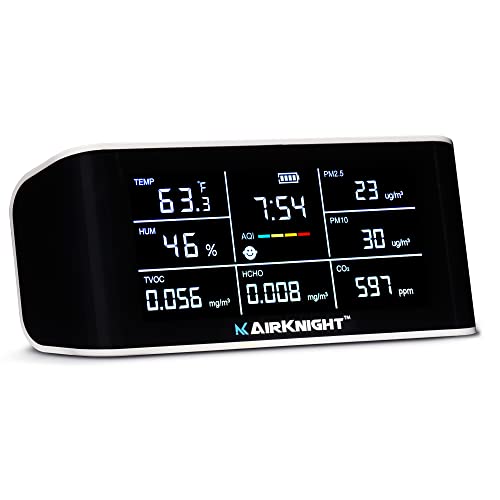
BREATHE Airmonitor Plus Indoor Air Quality Monitor w/CO, PM & App. Gen 2.
- app or voice
$99.99 Check pricePrices change often




Common questions
Can one air quality monitor accurately measure PM2.5, CO2, VOCs and radon all at once?
Not with equal accuracy. Each of those pollutants requires a different sensor technology, and an inexpensive device that measures all of them is typically using a lower-quality version of each sensor compared to a dedicated single-purpose device. A broad multi-sensor monitor is a reasonable general starting point, but it should not be treated as equally precise across every reading it shows.
What is the difference between a monitor that measures CO2 and one that measures CO?
Carbon dioxide, CO2, is a normal indoor byproduct of breathing that indicates how well-ventilated a room is; elevated levels signal stale air rather than immediate danger. Carbon monoxide, CO, is a separate, dangerous gas from incomplete combustion in appliances like furnaces or generators, measured by a different sensor entirely. A device measuring one does not necessarily measure the other.
Does a cheap VOC monitor give an exact chemical concentration?
Typically no. Most inexpensive VOC monitors use a metal-oxide sensor that reports a relative index, a number that rises and falls with overall VOC levels, rather than a calibrated concentration of a specific compound in parts per billion. The index is useful for spotting trends but should not be treated as a precise measurement.
Do I need a separate device to test for radon?
Yes. Radon is a gas that particulate, CO2, VOC and carbon monoxide sensors do not detect at all. A dedicated radon detector uses its own sensing method and produces a radon-specific reading, which is why it is recommended here as a separate purchase rather than a feature to look for in a general air quality monitor.
Is a high CO2 reading in a bedroom dangerous?
At typical indoor levels, elevated CO2 is not itself toxic, but it is a reliable sign that a room is under-ventilated, which can correlate with stuffiness and reduced alertness. It is a different measurement and a different concern from carbon monoxide, which is dangerous at much lower concentrations and comes from combustion sources rather than breathing.
Which monitor should I buy if I have not identified a specific air quality concern yet?
A general-purpose monitor covering PM2.5, CO2, VOCs and carbon monoxide together, like the top pick on this page, gives a broad first look across several pollutants at once. It is a reasonable starting point precisely because it is not yet clear which specific pollutant, if any, is the actual issue in that home.