Ideal indoor humidity levels and window condensation limits by outdoor temperature
Quick answer
Indoor relative humidity should stay between 30 and 50 percent year-round. In winter, cap indoor humidity based on outdoor temperature to prevent window condensation: 45 percent at 40F, 35 percent at 20F, 25 percent at 0F or colder.

Antonki 2 Pack Room Thermometer Indoor Hygrometer
A machine that publishes a real airflow figure, so the arithmetic on this page can actually be applied to it.
Coverage claims vary in what air change rate they assume, so check a published airflow figure against your own room rather than the room size on the box.
| Outdoor temperature | Maximum indoor RH | Why this limit |
|---|---|---|
| 50F and above | 50% | No condensation risk; focus on comfort |
| 40F | 45% | Window condensation begins above this |
| 30F | 40% | Serious condensation risk at higher humidity |
| 20F | 35% | High condensation on double-pane windows |
| 10F | 30% | Condensation on any window; mold risk |
| 0F and below | 25% | Extreme dryness prevents any condensation |
The ideal humidity range for health and comfort
Most people feel comfortable between 30 and 50 percent relative humidity. Below 30 percent feels dry and irritates skin, eyes, and airways. Above 50 percent supports mold, dust mites, and musty smells.
Winter heating creates a challenge: when outdoor air is cold and dry (low absolute humidity), heating it indoors lowers the relative humidity further. A 40-degree day with 60 percent outdoor humidity becomes 20 percent humidity indoors after heating, which is dry enough to crack lips and trigger asthma.
Summer cooling works the opposite way: outdoor humidity increases indoors when you cool air. Without dehumidification, indoor humidity climbs above 50 percent in humid climates, supporting mold and dust mites.
Why humidity matters
- Below 30% RH: Dry skin, sinus irritation, asthma triggers, static electricity
- Between 30-50% RH: Optimal comfort and health
- Between 50-60% RH: Dust mite population grows; mold spores begin to germinate
- Above 60% RH: Active mold growth, musty odors, structural damage
Winter heating and the condensation problem
Cold outdoor air holds very little moisture. A 30-degree day at 70 percent relative humidity is only about 3.5 grams of water per cubic meter of air. When you heat that air to 72 degrees indoors, the same 3.5 grams in dry indoor air is only about 20 percent relative humidity.
If you add humidity indoors with a humidifier (a common winter comfort fix), the warm indoor air can hold more moisture without condensing. But if indoor air gets too humid, it will condense on cold surfaces like windows and exterior walls, especially at night.
The dew point is the temperature at which air becomes saturated and condenses. If your indoor air is 72 degrees and 45 percent humidity, the dew point is about 45 degrees. If a window surface drops below 45 degrees (because it is in contact with 35-degree outdoor air), condensation forms on the inside of the window.
Why the humidity cap gets lower in colder weather
At 50 degrees outdoors, a window surface is about 45 to 48 degrees even on the inside, so indoor humidity can be 50 percent without condensation.
At 20 degrees outdoors, the window surface is closer to 25 degrees, so the dew point limit for indoor air is about 35 percent humidity.
At 0 degrees or below, windows are very cold on the inside. Indoor humidity above 25 percent starts to condense on windows or on cold spots in exterior walls.
This is why Midwestern and Canadian homes are so dry in winter: heating very cold outdoor air and then capping humidity at 25 percent is the only way to prevent water damage to walls and windows.
Humidifiers in winter and the condensation trap
Winter humidifiers feel good, but they create a risk: adding moisture indoors without increasing outdoor air intake raises indoor absolute humidity, which means the dew point rises. If you do not know your outdoor temperature and adjust the humidity to a safe level, you will get window condensation.
The safest approach is to buy a hygrometer (a humidity meter) and keep it near your windows. If you see condensation forming, lower the humidifier setting. Better yet, use a humidifier with a built-in hygrometer or sensor that caps humidity automatically.
Alternatively, on very cold days, crack a window for 5 to 10 minutes every few hours to exchange dry indoor air for dry outdoor air. This removes excess moisture without heating the home further.
Summer humidity and air conditioning
Air conditioning removes humidity from indoor air as it cools. The cooling coil is below the dew point of the incoming air, so moisture condenses on the coil and drains away.
In humid climates, if your air conditioner is undersized or not running enough, indoor humidity climbs. If indoor humidity exceeds 60 percent in summer, mold can grow. A dehumidifier running alongside the air conditioner can help.
The target in summer is the same: 30 to 50 percent. If your AC is keeping the house at 50 percent in summer, it is working well. If humidity is stuck at 60 percent or higher, the AC is too small for the cooling load, or you need to close doors to balance room-to-room humidity.
Equipment mentioned on this page
- TempPro
TempPro TP50 Digital Hygrometer Indoor Thermometer Room Thermometer
$12.99 Check pricePrices change often - Govee
Govee Indoor Hygrometer Thermometer H5075 with Bluetooth App Control
- app or voice
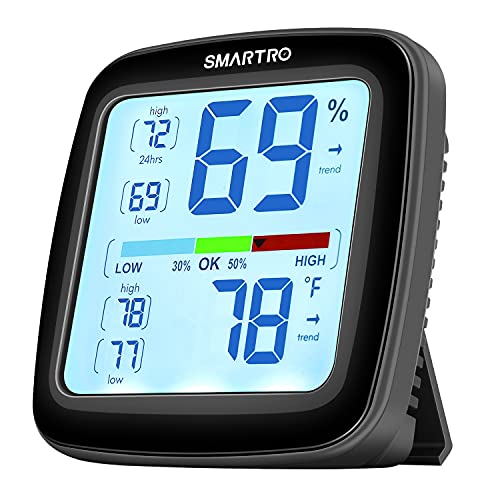
$12.99 Check pricePrices change often - SMARTRO
SMARTRO SC42 Professional Digital Hygrometer Indoor Room Thermometer
$18.99 Check pricePrices change often - TempPro
TempPro TP49 3 Pack Digital Hygrometer Indoor Thermometer
$20.89 Check pricePrices change often




Common questions
How do I measure indoor humidity?
Buy a hygrometer, a small device that displays temperature and relative humidity. They cost 10 to 25 dollars. Place it in the room you are trying to control, away from direct heating or cooling sources. Check it once a week to track humidity. Smart models upload data to your phone.
My windows sweat in winter. What should I do?
Window condensation means indoor humidity is too high for the outdoor temperature. Lower your humidifier setting by 5 to 10 percent, or turn it off for a few days. If condensation persists, your windows may be single-pane or very old: the glass is too cold. Upgrading to double or triple-pane windows helps.
Can humidity cause mold on walls, not just windows?
Yes. If indoor humidity is above 50 percent for days at a time, and if cold air infiltrates through exterior walls (especially in corners or under windows), the wall surface temperature can drop below the dew point. Mold grows in that condensation. Proper insulation and air sealing help prevent this.
Should I run a humidifier all winter?
Not necessarily. Winter air is naturally very dry, and adding humidity is usually not needed unless you have specific symptoms like cracked lips or asthma triggers. If you do run a humidifier, keep indoor humidity between 30 and 40 percent, and use a hygrometer to check that window condensation does not form.
What is the difference between relative humidity and absolute humidity?
Relative humidity (RH) is the percentage of moisture the air can hold at that temperature. Absolute humidity is the actual amount of water in the air, measured in grams per cubic meter. Cold air can hold less moisture than warm air, so cold outdoor air can have high RH but very low absolute humidity. This is why winter is so dry.