MERV 1 to 16 filters: particle capture by size and typical use
Quick answer
MERV ratings from 1 to 16 measure how well a furnace filter captures particles. MERV 1 to 4 blocks only large dust; MERV 8 is standard residential; MERV 11 to 13 is for allergies; MERV 16 approaches HEPA performance. Higher MERV reduces airflow, so choose the highest your furnace supports.
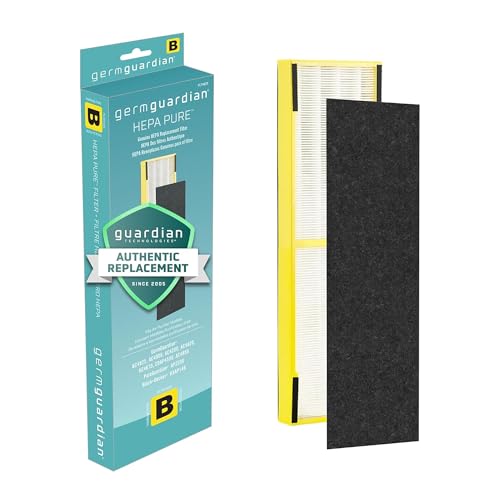
GermGuardian, Filter B HEPA Pure Genuine Air Purifier Filter, Removes 99.97% of Pollutants, Wildfire Smoke, Odors, for Ac4825, Ac4300, Ac4850, Ac4880, Ac4900, Cdap4500, Ap2200, Flt4825
A machine that publishes a real airflow figure, so the arithmetic on this page can actually be applied to it.
Coverage claims vary in what air change rate they assume, so check a published airflow figure against your own room rather than the room size on the box.
| MERV | Large (E1, 3-10 µm) | Medium (E2, 1-3 µm) | Small (E3, 0.3-1 µm) | Typical use |
|---|---|---|---|---|
| 1 | 20-30% | N/A | N/A | Basic fiberglass, not recommended |
| 2 | 20-35% | N/A | N/A | Basic fiberglass, not recommended |
| 4 | 25-40% | N/A | N/A | Budget fiberglass, poor performance |
| 5 | 40-50% | 20-30% | N/A | Light commercial, basic residential |
| 6 | 50-60% | 30-40% | N/A | Light commercial, basic residential |
| 7 | 60-70% | 40-50% | N/A | Commercial, some residential |
| 8 | 80-85% | 65-75% | 40-50% | Standard residential furnace filter |
| 9 | 85-90% | 75-85% | 50-60% | High-capacity residential |
| 10 | 90% | 85% | 60-70% | High-capacity residential |
| 11 | 92-95% | 90-95% | 75-80% | Allergy and asthma households |
| 12 | 95-98% | 95-98% | 80-85% | Allergy and asthma households |
| 13 | 98-99% | 98-99% | 90-95% | Sensitive lungs; reduced airflow |
| 14 | 99% | 99% | 95-97% | Institutional; requires airflow support |
| 15 | 99% | 99% | 97-99% | Institutional; requires airflow support |
| 16 | 99%+ | 99%+ | 99.97% | Approaches HEPA; rarely used in furnaces |
What MERV means and how it is tested
MERV stands for Minimum Efficiency Reporting Value, a standard published by ASHRAE, the American Society of Heating, Refrigerating and Air-Conditioning Engineers. The test method is ASHRAE 52.2.
The test measures efficiency at three particle size ranges. E1 is 3 to 10 microns (large particles like dust and pollen). E2 is 1 to 3 microns (medium particles like dust mites and some bacteria). E3 is 0.3 to 1 micron (small particles like smoke, wildfire particles, and viruses).
A filter is rated at the lowest of the three bands. If a filter is 80 percent efficient at E1 but only 60 percent at E3, it is rated MERV 8. The MERV number tells you the worst-case efficiency, not the average.
MERV 1 to 4: cheap filters with poor performance
These are basic fiberglass filters found in budget furnace replacements. They block only the largest dust particles: hair, visible lint, and chunks of debris. They do not capture dust mite allergen, pollen, or smoke.
MERV 4 is sometimes used in commercial spaces where filters are changed frequently and indoor air quality is not critical. For home use, do not buy MERV 4 or lower: you pay as much to install as you would for a MERV 8 filter with five times better performance.
MERV 5 to 8: standard residential filters
MERV 8 is the baseline for residential furnace filters and the most common replacement. It captures 80 to 85 percent of large dust, 65 to 75 percent of medium particles, and 40 to 50 percent of small particles like wildfire smoke.
MERV 5 to 7 are used in light commercial spaces and budget residential applications. They cost slightly less than MERV 8 but provide noticeably worse performance on small particles, so the savings are not worth it unless airflow is critical.
Most furnaces are designed for MERV 8 without airflow penalty. A standard 16 by 25 by 1 inch MERV 8 filter costs 10 to 15 dollars and lasts 90 days in an average home.
MERV 9 to 12: allergy and asthma
MERV 11 and 12 are recommended for households with allergies, asthma, or other respiratory sensitivity. They capture 90 to 98 percent of large dust and pollen, and 80 to 95 percent of small particles.
MERV 13 is the next step up, but it may reduce airflow on older furnaces. Before upgrading to MERV 13, check your furnace manual or consult an HVAC technician. Restricting airflow can damage the furnace.
The cost of MERV 11 to 12 is 20 to 30 dollars per filter, about twice the cost of MERV 8, but the improved capture of allergens and wildfire smoke is worth it for sensitive households. Filters still last 90 days.
MERV 13 to 16: institutional and commercial
MERV 13 to 16 filters approach HEPA performance, with 98 percent or higher capture at all particle sizes. MERV 16 captures 99.97 percent at 0.3 microns, the same standard as HEPA.
These filters are expensive (40 to 60 dollars per filter), reduce airflow significantly, and are rarely used in residential furnaces because of airflow penalties. They are found in hospitals, laboratories, and commercial spaces where air quality is critical.
If you need MERV 13 level filtration at home, a room-sized HEPA air purifier is often more practical than trying to force a high-MERV filter through your furnace. The purifier filters independently without loading your furnace.
Furnace airflow and filter selection
Your furnace is designed to push air through a certain MERV rating. Using a filter higher than the furnace supports reduces airflow, which can crack the heat exchanger from thermal stress or trigger high-limit safety switches.
Before upgrading from MERV 8 to MERV 13, check your furnace specifications or ask an HVAC technician what maximum MERV is safe. Many furnaces support up to MERV 11 without issue. Older furnaces may be limited to MERV 8.
If your furnace supports only MERV 8 but you want better air quality, a portable HEPA purifier is the solution. It does not affect furnace airflow and gives you the benefit of true HEPA filtration.
Equipment mentioned on this page
- Borgodf
Borgodf B-D02L/M05 Replacement Filter for MOOKA B-D02L & M05 Air Purifier
- HEPA claimed
- carbon stage
$17.98 Check pricePrices change often - Sinnya
12020 11020 HEPA Replacement Filter for Clorox Air Purifier 11020 & 11021
- HEPA claimed
$19.66 Check pricePrices change often - Cabiclean
Blue Pure Replacement Filter for Blueair 411, 411+, 411 Auto Air Purifier
- carbon stage
$19.89 Check pricePrices change often - Clorox
Clorox Tabletop Air Purifier True HEPA Replacement Filter, 200 Sq. Ft.
- HEPA claimed
$19.99 Check pricePrices change often - Borgodf
2 Pack HP102 Replacement Filter Compatible with Shark HP102 Air Purifier
- HEPA claimed
- carbon stage
$21.37 Check pricePrices change often - Cabiclean
HPA300 HEPA Filter Replacement for Honeywell, Replace HRF-R3 & HRF-A300
- HEPA claimed
- carbon stage
$21.99 Check pricePrices change often


Common questions
Can I stack two MERV 8 filters for better performance?
No. Stacking filters does not improve efficiency much, and it drastically reduces airflow. A single MERV 11 filter performs better than two MERV 8 filters stacked, and it does not choke your furnace. Use one filter at the maximum MERV your furnace supports.
Does MERV 13 work like HEPA?
MERV 13 captures 98 to 99 percent at 0.3 microns, while HEPA captures 99.97 percent. They are close but not identical. More importantly, MERV 13 filters in furnaces are airflow-limited, while HEPA filters in dedicated purifiers move high volumes of air. For best results, use MERV 11 in the furnace and a HEPA purifier in your bedroom.
How often do I change a MERV filter?
A MERV 8 filter in an average home lasts 90 days. Higher MERV filters load faster and may need changing every 60 days, especially if you have pets or live with wildfire smoke. Check the filter once a month: if it looks gray and clogged, replace it early.
Will upgrading to MERV 11 hurt my furnace?
Most modern furnaces support MERV 11 without issue. Older furnaces (pre-2000) may struggle. Check your furnace manual for the maximum recommended MERV. If it says MERV 8 maximum, do not exceed that: the risk to the furnace is not worth it. Use a portable HEPA purifier instead.
Does MERV rating apply to all furnace filter sizes?
Yes. A MERV 8 filter is MERV 8 whether it is 16x25x1 or 16x25x5 inches. The size does not affect the efficiency rating; it only affects how much dust the filter can hold before clogging. Larger filters (4 to 5 inch) last longer before needing replacement.