Humidifier output sizing
Quick answer
Holding 1,000 square feet at 35 percent relative humidity against 20 degree Fahrenheit outdoor air takes roughly 3.5 gallons of water a day, assuming an eight foot ceiling and half an air change an hour of infiltration. That is console territory rather than a tabletop tank, which is why a small humidifier in a large room never reaches its setting. Aiming at 40 percent in that weather is refused here on purpose: it condenses on ordinary double glazing.
Put a hygrometer somewhere other than beside the machine. A humidifier reads the dampest air in the room by definition, which is the air it has just humidified.
Ultrasonic machines put dissolved minerals into the room as white dust unless you use distilled water. Evaporative machines use a wick that holds the minerals instead, and the wick is a running cost.
Assumes the house at 70 degrees Fahrenheit, outdoor air at 70 percent relative humidity at the stated temperature, and half an air change an hour of infiltration. A draughty older house needs more and a tight new build needs less. Moisture from people, cooking and showers is not counted.

Levoit Humidifiers for Bedroom, Quiet, 3L Cool Mist, Essential Oil Diffuser
A machine that publishes a figure you can actually compare against the answer above, rather than a coverage area with no air change rate behind it.
Prices and specifications change, so check the listing against the number this calculator gave you.
Humidifiers and a hygrometer to check the result
- TempPro
TempPro TP50 Digital Hygrometer Indoor Thermometer Room Thermometer
$12.99 Check pricePrices change often - Govee
Govee Indoor Hygrometer Thermometer H5075 with Bluetooth App Control
- app or voice
$12.99 Check pricePrices change often - SMARTRO
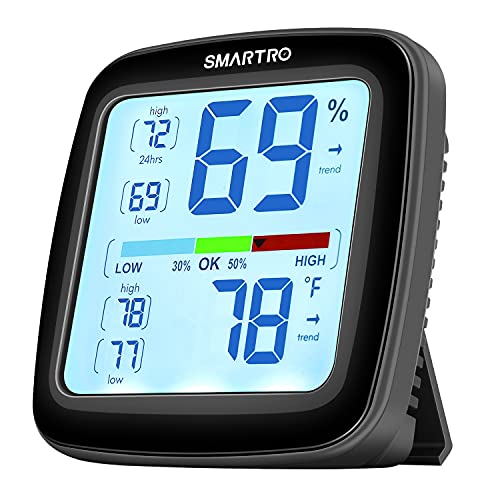
SMARTRO SC42 Professional Digital Hygrometer Indoor Room Thermometer
$18.99 Check pricePrices change often



Common questions
What indoor humidity should I aim for?
Between 30 and 50 percent relative humidity. In cold weather the binding constraint is condensation rather than comfort: at 20 degrees Fahrenheit outside, about 35 percent indoors is as high as ordinary double glazing tolerates, and the ceiling falls further as it gets colder.
Why does my humidifier never reach its setting?
Almost always because its output is smaller than the rate at which dry air is arriving. Infiltration brings cold dry air in continuously, it is heated, and it leaves carrying the moisture you added. If the machine puts in less water per hour than that process removes, the humidity settles below the setting no matter how long it runs.
Is a whole house humidifier better than portable units?
For a whole house, yes, with one caveat: a ducted humidifier only adds moisture while the furnace blower is running, so in mild weather it does much less than its rating suggests. Portable units work whenever they are switched on but need filling, and several of them cost more in wicks and attention than one console.
Does the humidifier type change the sizing?
No. The water balance is the same whatever the machine, so the gallons per day figure holds for evaporative, ultrasonic, steam or ducted. What changes is the running cost, the mineral handling and the noise, not how much water the house needs.
Can too much humidity cause damage?
Yes, and it is the common failure in cold weather. Condensation on windows, damp patches on cold exterior walls and mould in window frames all mean the indoor humidity is above what the building tolerates at that outdoor temperature. Lower the setting rather than trying to ventilate around it.