MERV 13 furnace filter vs a portable air purifier
Quick answer
A MERV 13 furnace filter like the Filtrete 20x25x1 ($36.99 for a 2 pack) increases static pressure on an HVAC blower that was not necessarily designed for it, while a portable purifier like the GermGuardian AC4825E ($80.74) uses a fan and filter engineered together, which is why upgrading a furnace filter alone does not always deliver the airflow a portable unit does.
Not every furnace blower is rated for MERV 13. Check your system before upgrading a 1-inch slot past what the manufacturer specifies.

GermGuardian HEPA Air Purifier - Large Room Air Purifier for Bedroom, Office, Dorm, and Home - Filters Pet Dander, Dust, Pollen, Smoke, Scents - AC4825E - 22" Tower - Gray
A dedicated portable unit like the GermGuardian AC4825E moves air with a fan sized specifically for its own filter, so you know what you are getting without checking whether an HVAC system can tolerate the added resistance.
Coverage claims vary in what air change rate they assume, so check a published airflow figure against your own room rather than the room size on the box.
| MERV 13 furnace filter (Filtrete 20x25x1) | Portable purifier (GermGuardian AC4825E) | |
|---|---|---|
| Price | $36.99 for a 2 pack | $80.74 unit |
| Standard used | MERV under ASHRAE 52.2 | Coverage claim, no CADR listed |
| Runs when | Only while the HVAC blower runs | Continuously on its own fan |
| Static pressure effect | Adds resistance to existing ductwork | None: self-contained fan and filter |
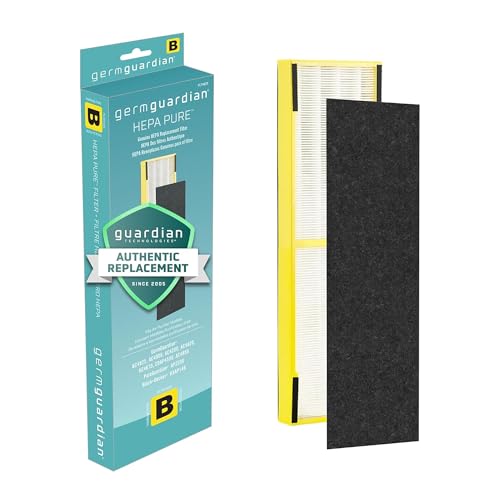
| Replacement filter | The filter itself is the replaceable part | $29.99 filter, roughly 8 month claim on this listing |
Filter dimensions and the guessing game they create
Furnace filters are sold by physical dimension first, MERV rating second: a homeowner has to know their exact filter slot size, commonly 16x20x1, 20x25x1, or a deeper 4-inch cabinet size, before MERV rating is even a relevant choice. Buying the wrong dimension by even a fraction of an inch means a filter that does not seal properly in the slot, letting unfiltered air bypass the filter media entirely regardless of how high its MERV rating is.
A portable purifier removes this guessing game because the filter is proprietary to that specific model and sold under the model name rather than a generic dimension, so there is no separate step of measuring a slot before ordering the correct replacement. The trade-off is that a proprietary filter is only available from that one manufacturer and its aftermarket, while a generic furnace filter dimension is sold by dozens of brands at a competitive price.
What static pressure has to do with a MERV upgrade
Every HVAC system is designed around an expected resistance to airflow, called static pressure. A denser filter, which is what a higher MERV rating generally means, restricts airflow more than a looser one. Jumping from a MERV 8 filter to a MERV 13 filter in the same 1-inch slot can meaningfully raise static pressure if the blower and ductwork were sized around the lower rating.
The practical result of too much static pressure is a blower working harder to move the same amount of air, which can mean reduced airflow at the registers, more strain on the blower motor, and in poorly matched systems, ice buildup on an evaporator coil in cooling mode. This is why HVAC technicians generally recommend checking the rated static pressure tolerance of your system before installing a MERV 13 filter, rather than assuming higher MERV is a free upgrade. A technician measuring static pressure with a manometer before and after a filter change is the definitive way to know whether a specific system tolerates the upgrade.
A portable purifier does not have this problem
A unit like the GermGuardian AC4825E is engineered as a closed system: the fan, the housing, and the filter are matched by the manufacturer to move a specific amount of air through that specific filter media. There is no separate ductwork to strain and no existing blower motor being asked to do more than it was built for.
This is a structural advantage independent of filter quality. Even a MERV 13 filter with excellent particle capture only helps if enough air actually gets pushed through it, and a portable unit is built around delivering that airflow by design rather than by accident of what a furnace happened to be sized for years before MERV 13 was considered. Manufacturers of portable units publish a rated airflow figure precisely because that number, not the filter media alone, determines how much air actually gets treated in a given hour.
The duty cycle difference
A furnace filter, MERV 13 or otherwise, only filters air while the blower is moving it, and on a thermostat set to "auto" that blower runs on a call for heat or cooling, not a call for clean air. Cleaning happens in bursts tied to your thermostat setpoint, not continuously.
A portable purifier like the GermGuardian AC4825E runs on its own switch, independent of the thermostat. Left on, it filters continuously regardless of whether the furnace or air conditioner is calling for anything. For a specific room where you want consistent filtration, that continuous duty cycle matters more than a marginally higher MERV rating running intermittently. This gap is largest in mild weather, spring and autumn stretches when a thermostat may barely call for heat or cooling for days at a time, leaving a furnace filter almost entirely idle while a portable unit keeps working.
What MERV and CADR are each actually testing
MERV, short for Minimum Efficiency Reporting Value, comes from ASHRAE 52.2, a standard that tests how well a filter medium captures particles of different sizes as air is pushed through it once, under controlled lab conditions. A MERV 13 rating means the filter meets a specific capture efficiency across a range of particle sizes at that single pass. It says nothing about how much air your specific furnace blower actually pushes through it.
CADR, the number that matters more for a portable unit, comes from AHAM AC-1, a completely different test that measures clean air delivered per minute in a sealed 1,008 cubic foot chamber, combining both the filter media and the fan moving air through it. Where a portable purifier listing states CADR, it is a more complete real world performance number than a bare MERV rating on a furnace filter, because it already accounts for the fan doing the work of pushing air through the media.
Sound and where each option puts the noise
A furnace blower running to push air through a denser MERV 13 filter typically operates from a mechanical room, closet, or basement, physically separated from the living space, so any added noise from increased resistance is muffled by distance and building materials before it reaches a bedroom or living room.
A portable purifier like the GermGuardian AC4825E sits directly in the room it serves, which means its fan noise is immediate rather than distant. This is a real trade-off against the continuous duty cycle advantage: a portable unit running on a higher fan speed for stronger air changes is also the loudest thing in the room, while a furnace blower working harder in another part of the house is comparatively unnoticed.
What the yearly cost actually looks like
The Filtrete 20x25x1 MERV 13 filter sells as a 2 pack for $36.99, or about $18.50 per filter. A common industry guideline for a 1-inch pleated filter is to replace it roughly every three months regardless of MERV rating, since dust loading, not fiber rating, usually determines when airflow starts to suffer; at that pace, four filters a year runs about $74.00 annually for the filter alone, before counting any efficiency loss from added static pressure.
The GermGuardian AC4825E pairs with a genuine filter at $19.88, or with an aftermarket option like the Pulluty replacement rated for around 8 months on its listing, working out to roughly 1.5 filters a year. At the genuine filter price, that is under $30 a year in filter cost, on top of a bit of ongoing electricity for the standalone fan. Neither number accounts for the value of continuous operation against intermittent operation, which is a real difference in exposure time even when the raw dollar figures land close together. Add a rough electricity estimate for whichever option you are actually running for most of the day before treating either total as the full cost of ownership, since a fan running continuously for years on end adds up even at a modest wattage.
Equipment mentioned on this page
- Borgodf
Borgodf B-D02L/M05 Replacement Filter for MOOKA B-D02L & M05 Air Purifier
- HEPA claimed
- carbon stage
$17.98 Check pricePrices change often - Sinnya
12020 11020 HEPA Replacement Filter for Clorox Air Purifier 11020 & 11021
- HEPA claimed
$19.66 Check pricePrices change often - Cabiclean
Blue Pure Replacement Filter for Blueair 411, 411+, 411 Auto Air Purifier
- carbon stage
$19.89 Check pricePrices change often - Clorox
Clorox Tabletop Air Purifier True HEPA Replacement Filter, 200 Sq. Ft.
- HEPA claimed
$19.99 Check pricePrices change often - Borgodf
2 Pack HP102 Replacement Filter Compatible with Shark HP102 Air Purifier
- HEPA claimed
- carbon stage
$21.37 Check pricePrices change often




Common questions
Is a MERV 13 filter always a bad idea for a residential furnace?
Not always, but it depends entirely on the specific system. Some newer furnaces and larger ductwork handle MERV 13 without issue, while older systems designed around MERV 8 can see reduced airflow or added strain. Check your equipment manual or ask an HVAC technician before upgrading past what the manufacturer specifies for your filter slot.
Does a portable purifier replace the need for a good furnace filter?
No, they address different air. A furnace filter treats air moving through the ducts whenever the blower runs, reaching every connected room. A portable purifier treats only the room it sits in, continuously. Most homes benefit from a reasonable furnace filter and a portable unit in the room that matters most, rather than choosing only one.
Why does the portable purifier not list a CADR number here?
Not every purifier listing publishes an AHAM AC-1 CADR figure even though the test exists for the category. Where CADR is missing, coverage claims and filter type are the next best comparison points, understanding that coverage claims depend on an air change rate the manufacturer does not always state.
How do I know if my furnace filter is restricting airflow too much?
Signs include weaker airflow at registers, the system running longer to reach setpoint, or unusually high static pressure if you have a technician measure it with a manometer. A visibly dirty or clogged filter compounds any static pressure issue already caused by a higher MERV rating.
Can I run both a MERV 13 furnace filter and a portable purifier in the same room?
Yes, and doing so is not redundant. The furnace filter handles baseline air quality across the whole ducted system whenever the blower runs, while the portable purifier adds continuous, higher-intensity filtration specifically in that room, independent of the thermostat cycle.