Air purifier sizing for a kitchen
Quick answer
A kitchen is sized at 6 air changes an hour against a 8 foot ceiling on this site, so a 200 square foot one needs about 160 CFM of clean air delivery. The table below runs from 100 to 350 square feet.
| Floor area | Volume | At 2 ACH | At 6 ACH | At 6 ACH |
|---|---|---|---|---|
| 100 sq ft | 800 cu ft | 27 CFM | 80 CFM | 80 CFM |
| 120 sq ft | 960 cu ft | 32 CFM | 96 CFM | 96 CFM |
| 150 sq ft | 1,200 cu ft | 40 CFM | 120 CFM | 120 CFM |
| 175 sq ft | 1,400 cu ft | 47 CFM | 140 CFM | 140 CFM |
| 200 sq ft | 1,600 cu ft | 53 CFM | 160 CFM | 160 CFM |
| 250 sq ft | 2,000 cu ft | 67 CFM | 200 CFM | 200 CFM |
| 300 sq ft | 2,400 cu ft | 80 CFM | 240 CFM | 240 CFM |
| 350 sq ft | 2,800 cu ft | 93 CFM | 280 CFM | 280 CFM |

WINIX 5510 Air Purifier (New Generation of 5500-2 with App Support) for Home Large Room Up to 1881 Ft2 in 1 Hr, True HEPA, High Deodorization Carbon Filter and Auto Mode, Captures Pet Allergies, Smoke
This machine can be credited with about 502 CFM, derived from the listing's own figures: 1881 sq ft at 2 air changes an hour, assuming an eight foot ceiling. That clears the 160 CFM this room calls for.
Check the noise at the speed that delivers the airflow, not the figure quoted for the lowest setting.
Every size in this room type
What makes a kitchen different
The usual sources in this room are frying and searing, which produce fine particles in quantity, toast and grilling, gas hob combustion products. That mix is what decides whether the carbon stage matters as much as the particle stage, and it is why the same square footage in two different rooms does not always call for the same machine.
Cooking is the fastest way to spike particle counts in a home, and the numbers a monitor shows during a fry up surprise most people. Run the extraction hood on the back burners, and treat the purifier as the thing that clears what is left rather than as the primary control.
Which air change target this room is sized at
This section sizes a kitchen at 6 air changes an hour, the smoke and wildfire season case, which suits wildfire smoke, a woodstove that backpuffs, or smoke drifting in from outside. Two changes an hour is the comfort baseline and six is where smoke guidance sits.
The target is guidance rather than a measured threshold, so it is worth knowing what moving it does. Going from two changes an hour to 6 multiplies the airflow you need by 3, and the noise and the filter cost move with it.
Machines sized for this room
Each of these publishes either a CADR or a coverage claim with the air change rate behind it, so it can be compared against the requirement above.
- MOOKA
MOOKA H13 HEPA Air Purifier for Home Pet Large Room Up to 1300ft2, Black
- HEPA claimed
- carbon stage
- has a UV lamp
$46.98 Check pricePrices change often - MOOKA
MOOKA Air Purifiers for Home Room up to 1076ft2, True HEPA Filter, B-D02L
- HEPA claimed
- carbon stage
$49.99 Check pricePrices change often - MOOKA
MOOKA Air Purifiers for Home Room up to 1076ft2, True HEPA Filter, B-D02L
- HEPA claimed
- carbon stage
$49.99 Check pricePrices change often - Afloia
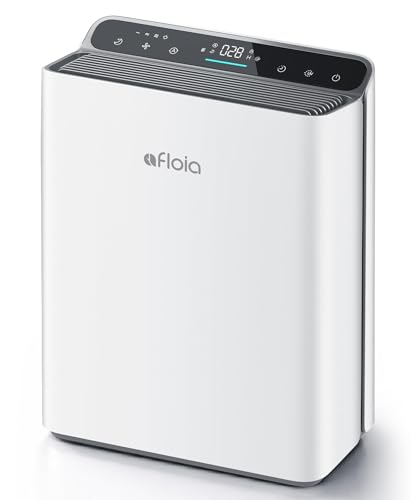
Afloia Air Purifier for Large Rooms Up to 2,000 Sq. Ft. with PM2.5 Display
- carbon stage
- washable pre-filter
- particle sensor
- auto mode
$79.99 Check pricePrices change often - KNKA
KNKA Air Purifiers for Home Bedroom Up to 1,695 Ft2 in 1 Hr, APH4000, White
- carbon stage
- washable pre-filter
- particle sensor
- auto mode
$119.97 Check pricePrices change often




Common questions
What size purifier does a kitchen need?
Multiply the floor area by the ceiling height, multiply by the air changes an hour you want, and divide by sixty. At 8 feet and 6 changes an hour, a 120 square foot kitchen needs about 96 CFM and a 350 square foot one needs about 280 CFM.
Should I buy one large unit or two smaller ones?
Two smaller machines usually mix a room better than one large one, because a single unit recirculates its own clean air in the corner it sits in. One larger machine is quieter for the same total airflow and costs less to keep in filters. If the room is long or L shaped, two is the better answer more often than the arithmetic alone suggests.
Does the door being open change the sizing?
It does, and by more than people expect. An open door connects the room to a hallway and often to a stairwell, and the machine is then serving that whole volume rather than the room on the floor plan. Either size for the connected space or close the door during the hours that matter.
Is a higher air change rate always better?
No. Airflow costs noise, power and filter life, and past a point the room is already as clean as the filter can make it. The honest ceiling is the arrival rate of whatever you are removing: on a smoke day more is genuinely better, and on an ordinary day in an ordinary house it is not.
Do these figures assume anything about the filter?
They assume the machine delivers its rated clean air delivery rate, which a clogged filter does not. A filter at the end of its life moves less air at the same fan speed, so the effective air change rate drops quietly over months without the machine sounding any different.