Sizing a dehumidifier for a extremely wet space
Quick answer
A extremely wet space is one where wet floor, damp laundry drying in the space, or seepage after rain. At that dampness a 500 square foot space needs about 16 pints a day, 1,000 square feet about 23 pints, and 2,000 square feet about 37 pints, measured on the 2019 DOE test conditions that current labels use.
| Floor area | Pints per day | Roughly which machine class |
|---|---|---|
| 500 sq ft | 16 pints | compact or 20 pint class |
| 1,000 sq ft | 23 pints | 30 to 35 pint class |
| 1,500 sq ft | 30 pints | 30 to 35 pint class |
| 2,000 sq ft | 37 pints | 50 pint class or larger |
| 2,500 sq ft | 44 pints | 50 pint class or larger |
| 3,000 sq ft | 51 pints | 50 pint class or larger |

avylo Dehumidifier for Basement with Pump and Hose, Max 90 Pints/D, White
Pint ratings on current labels are measured under the 2019 DOE test conditions, so compare like with like and ignore any chart written for the older test.
Continuous drainage to a floor drain is usually what decides whether the machine gets used at all, rather than whether it was the right size.
What counts as extremely wet?
Wet floor, damp laundry drying in the space, or seepage after rain. That description is the whole test, and it matters more than the square footage does: moving one class up or down changes the capacity by roughly a fifth at the same floor area.
Read the space rather than remembering it. Conditions change with the season, and a basement that is only musty in humid weather is a different class from one that is damp to the touch year round.
Why the class matters more than the label on the box
Pint ratings are measured under the 2019 DOE test conditions, which run cooler than the old test, so the same machine carries a lower number than it would have before 2019. A chart written for the old basis will send you a whole size class too large.
Oversizing is not harmless. A machine that satisfies the humidistat in fifteen minutes and then stops is cycling rather than drying, and the space ends up unevenly dry with the power bill of a larger machine.
What to fix as well as what to buy
Dampness has a source. Gutters discharging next to the wall, ground sloping toward the house, an unsealed crawl space floor or a cold water pipe sweating in summer are the usual four, and each is cheaper to fix than to dehumidify forever.
A dehumidifier is the right tool for the moisture that remains after that, and it is the wrong tool for standing water, which is a drainage failure and needs the drain fixed.
Dehumidifiers for this capacity
- GoGuess
GoGuess 1600 Sq.Ft Compressor Dehumidifier for Basement, Max 21 Pint/Day
$109.99 Check pricePrices change often - WHOY
WHOY 80 Pint Dehumidifier for Basement, 50 Pint DOE, Drain Hose, 5000 Sq Ft
- washable pre-filter
- app or voice
$159.98 Check pricePrices change often - BLACK+DECKER
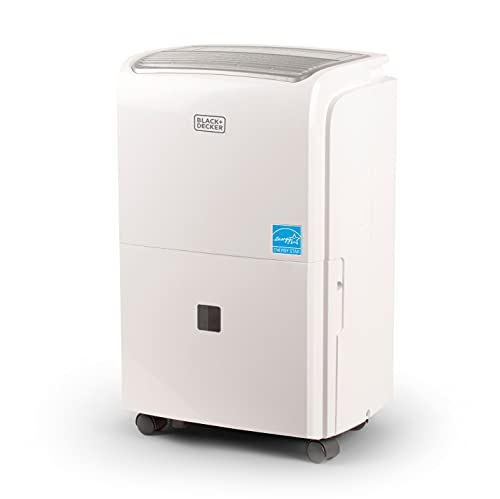
BLACK+DECKER 20-Pint Portable Dehumidifier, BDT20WTB, White
$182.09 Check pricePrices change often


Common questions
How do I know if my space is extremely wet?
The published classes describe conditions rather than measurements: wet floor, damp laundry drying in the space, or seepage after rain. If you want a number instead, put a hygrometer in the space for a week. Consistently above 60 percent relative humidity is the line where mould and dust mites do well, and it is the practical threshold to dry below.
Does a bigger unit dry faster?
It removes more per hour while it runs, so the initial dry down is faster. After that, the machine is only removing moisture as it arrives, and a larger machine spends that phase cycling on and off rather than running steadily. Size for the ongoing load, not the first week.
Should I run it all year?
Run it whenever the space is above the humidity you want, which in many houses means most of the warm half of the year and rarely in the cold half. A humidistat that switches the machine on and off for you is worth more than any other feature on the box.
Where should the machine sit?
Centrally, with clearance around the intake and outlet, and near a drain if you can manage it. A unit in a far corner with a wall against its intake is working against itself. If it must sit in a corner, leave the stated clearance on every side rather than the minimum on one.
Will a dehumidifier get rid of the musty smell?
It removes the conditions that produce it, which fixes the smell over days rather than instantly, because the existing growth and the material it is on are still there. Drying the space stops it getting worse, cleaning the affected surfaces deals with what is already there, and a purifier only captures spores already in the air.