Dehumidifier size for 2,000 sq ft
Quick answer
A 2,000 square foot space that is moderately damp needs roughly a 22 pint a day dehumidifier, rising to about 27 pints if it is very damp, 32 if it is wet, and 37 if it is extremely wet. Those are 2019 DOE test condition ratings, which are the ones on current labels and are roughly thirty percent lower than the pre-2019 numbers for the same physical machine.
Capacity figures come from the published sizing table for the 2019 DOE test conditions. Values between the published rows are interpolated here in a straight line.
| Dampness | How it feels | Pints per day |
|---|---|---|
| Moderately damp | the space smells musty in humid weather but is dry the rest of the year | 22 pints |
| Very damp | the space always smells musty and feels damp, and walls or floor are damp to the touch | 27 pints |
| Wet | you can see damp patches on the floor or walls, and the space has a constant musty smell | 32 pints |
| Extremely wet | wet floor, damp laundry drying in the space, or seepage after rain | 37 pints |
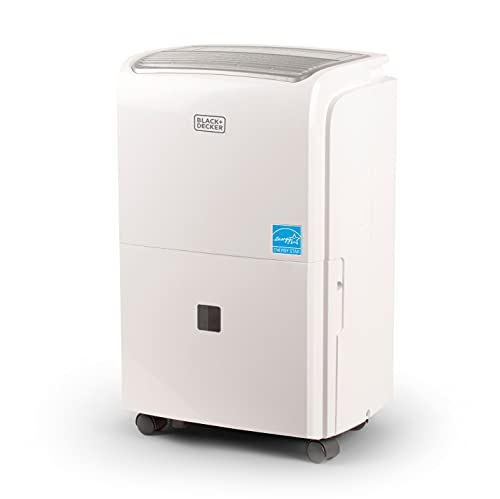
BLACK+DECKER 20-Pint Portable Dehumidifier, BDT20WTB, White
Pint ratings on current labels are measured under the 2019 DOE test conditions, so compare like with like and ignore any chart written for the older test.
Continuous drainage to a floor drain is usually what decides whether the machine gets used at all, rather than whether it was the right size.
| Floor area | Moderately damp | Very damp | Wet | Extremely wet |
|---|---|---|---|---|
| 500 sq ft | 10 | 12 | 14 | 16 |
| 1,000 sq ft | 14 | 17 | 20 | 23 |
| 1,500 sq ft | 18 | 22 | 26 | 30 |
| 2,000 sq ft | 22 | 27 | 32 | 37 |
| 2,500 sq ft | 26 | 32 | 38 | 44 |
| 3,000 sq ft | 30 | 37 | 44 | 51 |
What size dehumidifier for 2,000 square feet?
Sizing runs off two things and only two: the floor area and how damp the space genuinely is. For 2,000 square feet the answer ranges from about 22 pints a day if the space only smells musty in humid weather to about 37 pints a day if there is visible water or laundry drying in it.
The honest way to pick a class is to look rather than to remember. Damp to the touch, a constant smell, or visible patches are three different classes, and they are three different machines.
The pint rating change that makes old charts wrong
The DOE test conditions changed in 2019 and the test now runs at a lower chamber temperature, which is harder on a dehumidifier. The same physical machine that was sold as a 70 pint unit before the change is labelled around 50 pints after it.
That is why a sizing chart found online can disagree with the label in front of you by a whole size class. The table above uses the current basis. If you are reading a chart that recommends 70 pints for a basement, check whether it was written for the old test.
Drainage, and why it decides whether you use it
A machine pulling 27 pints a day out of the air fills a typical bucket in well under a day, which means emptying it daily and forever. Continuous drainage to a floor drain removes that entirely, and a built in pump lets it drain upward to a sink or a window.
In a basement this is usually the difference between a machine that runs and a machine that sits switched off with a full bucket. Check the hose fitting before buying rather than after.
What to aim for on the hygrometer
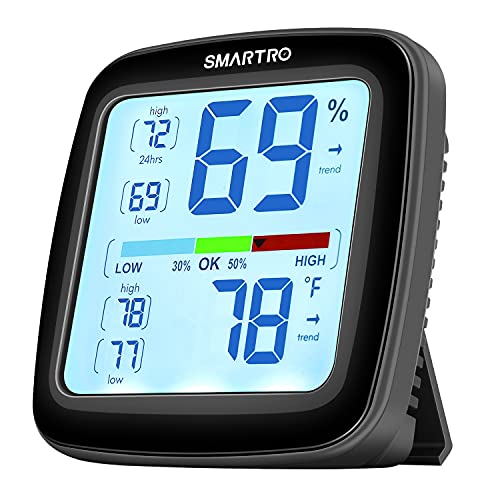
The target is relative humidity between 30 and 50 percent, and reliably under 60. Above 60 percent is where mould and dust mites do well, and that is the practical reason to dry a space rather than any comfort argument.
Buy a cheap hygrometer and put it where the problem is, not next to the machine. Most dehumidifiers read the air arriving at their own intake, which after an hour of running is the driest air in the room.
Dehumidifiers for this capacity
- TempPro
TempPro TP50 Digital Hygrometer Indoor Thermometer Room Thermometer
$12.99 Check pricePrices change often - Govee
Govee Indoor Hygrometer Thermometer H5075 with Bluetooth App Control
- app or voice
$12.99 Check pricePrices change often - SMARTRO
SMARTRO SC42 Professional Digital Hygrometer Indoor Room Thermometer
$18.99 Check pricePrices change often



Common questions
What size dehumidifier do I need for 2,000 square feet?
Between 22 and 37 pints a day depending on how damp the space is: about 22 pints if it only smells musty in humid weather, about 27 if it always feels damp, and up to 37 if there is visible water or wet laundry. These are 2019 DOE ratings, which is what current labels use.
Is a bigger dehumidifier always safer?
No. An oversized machine reaches the set humidity quickly, switches off, and cycles on and off repeatedly, which dries unevenly and wastes power. A right sized unit runs for longer stretches at a steadier output. Oversize deliberately only where the space is very cold or the moisture load is seasonal and extreme.
Will it work in a cold basement?
Standard compressor models lose capacity as the air gets colder and can frost up below roughly 65 degrees Fahrenheit unless they have an automatic defrost. For an unheated basement or a garage, look for a model that states low temperature operation, or a desiccant type, which does not mind the cold in the same way.
How long should it run each day?
Longer than people expect at first, then much less. Drying out materials that have been damp for months takes days of near continuous running, after which the machine is only removing what arrives. If it never stops running after the first week, the space is taking on water from somewhere and that is a drainage problem rather than a sizing one.
Do I need a dehumidifier or an air purifier?
They solve different problems. A dehumidifier removes water from the air, which is what stops mould growing and what makes a musty space smell normal again. A purifier removes particles already airborne, including spores, and does nothing about the moisture that produced them. In a damp basement the dehumidifier comes first.